

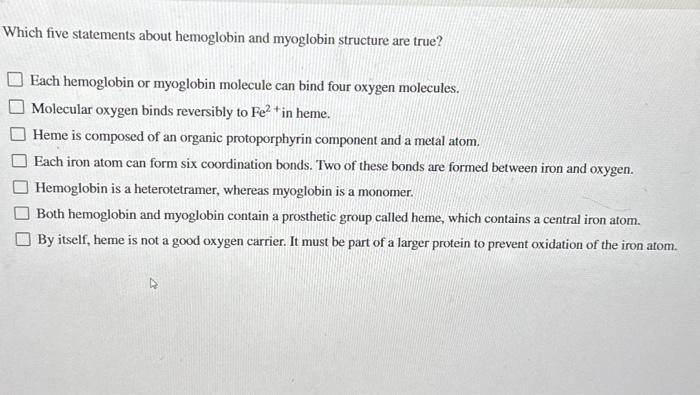
Within the intricate tapestry of molecular biology, hemoglobin and myoglobin stand out as essential proteins, akin to the steadfast sentinels of oxygen transport and storage within the human body. Both proteins perform critical functions, yet their roles are distinct, reflecting their nuanced design and evolutionary purpose. Here, we explore five definitive statements that elucidate the truths surrounding these remarkable proteins.
1. Hemoglobin Facilitates Oxygen Transport, While Myoglobin Serves as an Oxygen Reservoir
At the heart of their function lies the primary distinction: hemoglobin, the bustling conductor of oxygen transport, resides in red blood cells, and channels oxygen throughout the body’s vast circulatory network. In contrast, myoglobin, a solitary guardian, finds its home in muscle tissues, akin to a sentinel poised for action. It binds oxygen with a formidable affinity, enabling muscles to access necessary oxygen during periods of intense exertion. The difference is analogous to a bustling train station (hemoglobin) versus a quiet oasis (myoglobin)— one bustling with the vibrant flow of energy, and the other providing vital sustenance when needed most.
2. Hemoglobin Exhibits Cooperative Binding, Whereas Myoglobin Displays Strong Affinity for Oxygen
The mechanics of binding oxygen offer profound insight into their functionality. Hemoglobin’s structure is uniquely designed for cooperative binding, meaning that the binding of one oxygen molecule enhances the ability of additional oxygen molecules to bind. This phenomenon is illustrated through a conformational change that makes subsequent binding sites more accessible, much like how a well-conducted orchestra harmonizes, each instrument following the lead of the others to create a unified sound. Myoglobin, however, operates on a simpler basis, binding oxygen with a singular, robust affinity, showcasing a tenacity for oxygen akin to a devoted lover holding on through life’s vicissitudes. This property allows myoglobin to effectively capture and retain oxygen during muscle contractions, thereby ensuring a readily available supply during critical moments.
3. Hemoglobin and Myoglobin Have Distinct Structural Configurations
A closer examination of their structures reveals that both hemoglobin and myoglobin comprise polypeptide chains, yet their arrangements highlight their specialized roles. Hemoglobin consists of four subunits—two alpha and two beta chains—forming a quaternary structure that facilitates the aforementioned cooperative binding. Myoglobin, by contrast, consists of a single polypeptide chain arranged in a compact fold, reminiscent of a meticulously crafted piece of origami, allowing it to function effectively in binding oxygen. This structural divergence not only underscores their functionality but also reflects the evolutionary pressures that shaped their distinct pathways in oxygen dynamics.
4. The Colorimetric Difference Indicating Oxygen Saturation
Visually, the difference between these two proteins manifests itself through color. Oxygenated hemoglobin exhibits a vibrant red hue, an emblem of life, effectively distributing oxygen across the body, while deoxygenated hemoglobin shifts to a darker shade, reminiscent of dusk settling on the horizon. Myoglobin, on the other hand, possesses a darker color even when oxygenated, appearing purplish-red, embodying the quiet strength of the muscles it supports. This aesthetic variegation serves as a reminder of the delicate balance of oxygen cycling, an eloquent portrayal of the dichotomy between activity and rest.
5. Evolutionary Adaptations Reflecting Environmental Demands
The evolutionary trajectories of hemoglobin and myoglobin reveal fascinating insights into how organisms adapt to their environments. In species adapted to high-altitude living, hemoglobin often demonstrates enhanced binding affinity for oxygen, a requisite adaptation to thrive where oxygen levels are diminished. Myoglobin levels, too, may increase in animals engaging in sustained periods of vigorous activity, such as diving seals, allowing them to store greater reserves of oxygen. Thus, the evolutionary adaptability of these proteins acts as a testimony to the intricate interplay of life and survival, weaving through the annals of biology like threads in an elaborate tapestry.
In conclusion, hemoglobin and myoglobin serve as vital cornerstone proteins, each sculpted by evolutionary forces to fulfill specific roles that are essential for sustaining life. The exquisite engineering behind their cooperative binding, structural configurations, and distinct functions reflects the elegance of biological adaptation. The interplay of these proteins is a compelling narrative of survival, energy dynamics, and the inherent beauty of life itself, reminding us that the microscopic world is imbued with stories that bear significance far beyond their diminutive size.

Leave a comment