

In the realm of mathematics, fractions serve as the cornerstone of numerical representation, akin to the threads that weave together the fabric of arithmetic. To embark on our journey, we will delve into the question: “Which fraction is equivalent to 4/8?” This seemingly simplistic question opens the gateway to a deeper understanding of equivalency in fractions—an essential concept that extends beyond mere numbers. Through this exploration, we will unravel the enchanting nature of fractions, revealing their intrinsic beauty and significance.
First and foremost, let us dissect the fraction 4/8. This expression is a ratio, illustrating a part-to-whole relationship. Here, the numerator, 4, signifies the number of parts we possess, while the denominator, 8, denotes the total parts that constitute the entire set. When one encounters the fraction 4/8, a fascinating aspect emerges: it can often be simplified. Much like a caterpillar transforming into a butterfly, 4/8 metamorphoses into a more elegant form.
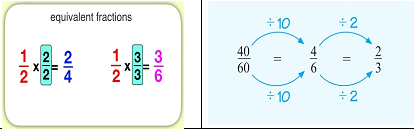
The simplification of fractions is akin to distillation; it involves refining the fraction to its most potent state. To simplify 4/8, we must discern the greatest common divisor (GCD) of both the numerator and the denominator. The GCD of 4 and 8 is 4, allowing us to divide both components by this value.
Carrying out this operation, we arrive at:
- Numerator: 4 ÷ 4 = 1
- Denominator: 8 ÷ 4 = 2
Thus, we arrive at the simplified fraction of 1/2. Herein lies the answer to our original inquiry: 4/8 is equivalent to 1/2.
But why does this equivalency matter? The answer transcends mere arithmetic; it penetrates the essence of understanding ratios and proportions. Imagine fractions as different flavors of ice cream. While they may initially appear dissimilar—vanilla, chocolate, and strawberry—they can embody the same sensation of sweetness, representing equivalent quantities. This metaphor highlights the underlying unity among seemingly disparate fractions.
Moreover, the mathematical landscape is dotted with an abundance of equivalent fractions. For instance, 4/8 is not alone in its equivalency. Other fractions that yield the same numerical value include:
- 2/4
- 3/6
- 6/12
The common thread binding these fractions is the property of equivalency, fundamentally illustrating how different ratios can culminate in identical outcomes. Each fraction is like a note in a symphony, creating harmony when played together, despite their distinct identities.
To further comprehend the breadth of equivalency, one may visualize a fraction as a dynamic entity within a larger mathematical ecosystem. For many learners, mastering equivalent fractions often requires a blend of conceptual understanding and practical application. Engaging in exercises that ask students to find equivalent fractions can be particularly illuminating; it fosters a deeper grasp of numerical relationships and enhances one’s confidence in mathematical reasoning.
Furthermore, the importance of equivalent fractions extends into real-world applications. Consider a scenario in culinary arts: a recipe calling for 4/8 cups of an ingredient may be simplified to 1/2 cups. This simplification can streamline ingredient measurements, allowing cooks to navigate their culinary endeavors with greater ease. Thus, the journey of understanding fractions melds seamlessly with everyday life, reinforcing the relevance of mathematical principles.
Another intriguing facet involves visual representations of fractions. Utilizing pie charts or number lines, educators can vividly illustrate how 4/8 and 1/2 occupy the same position in relation to a whole. Such graphical interpretations bridge the gap between abstract concepts and tangible comprehension. They serve not merely as tools for understanding but as artistic expressions of mathematical beauty.
To encapsulate the gamut of equivalent fractions, one must also consider the principles underlying operations involving fractions. Whether one is adding, subtracting, multiplying, or dividing, mastery of equivalent fractions is paramount. The notion of common denominators arises prominently in the context of addition or subtraction, while multiplication and division may require an understanding of inverse relationships.
In summation, the inquiry surrounding which fraction is equivalent to 4/8 opens a door to the grandeur of mathematical equivalency. Through simplification, visualization, and practical application, we glean insights that resonate within both academia and everyday life. In the grand tapestry of fractions, every thread has its place, contributing to the vivid tableau of numeracy. Embracing the full spectrum of equivalency invites us to appreciate mathematics not merely as a set of rules but as an art form—where fractions dance in unison, revealing the profound connections that unite them.
As we conclude this exploration, let us remember that the quest for understanding fractions transcends numbers. It beckons us to appreciate the elegance of ratios and the harmony woven into the mathematical fabric of life—a realm where 4/8 is not just a fraction, but a gateway to infinite possibilities.

Leave a comment