

When delving into the realms of mathematics, particularly in the study of fractions, one encounters the concept of equivalence. A profound understanding of equivalent fractions enhances our ability to manipulate numerical expressions and fosters a deeper appreciation for the beauty of mathematics. This exploration focuses specifically on the fraction 10/14, seeking to identify other fractions that hold equivalency with it. Through this examination, we will unravel the intricacies involved in deducing equivalency, utilizing methods such as simplification and the multiplication of fractions.
First, we must begin by simplifying the fraction 10/14. To achieve this, we need to ascertain the greatest common divisor (GCD) of the numerator (10) and the denominator (14). The GCD is the largest positive integer that divides both numbers without leaving a remainder. For 10 and 14, the GCD is 2. Dividing both the numerator and the denominator by this value yields:
- 10 ÷ 2 = 5
- 14 ÷ 2 = 7
Thus, the simplified form of 10/14 is 5/7. This simplified fraction serves as a pivotal reference point, as any fraction equivalent to 10/14 must also simplify to 5/7. Understanding this equivalency is instrumental in deriving other related fractions.
To produce equivalent fractions, one can multiply both the numerator and denominator of the simplified fraction by the same non-zero integer. This mathematical manipulation allows for the generation of a plethora of equivalent fractions. For instance:
- Multiplying both by 2: 5 × 2 = 10 and 7 × 2 = 14, yielding 10/14.
- Multiplying both by 3: 5 × 3 = 15 and 7 × 3 = 21, yielding 15/21.
- Multiplying both by 4: 5 × 4 = 20 and 7 × 4 = 28, yielding 20/28.
- Multiplying both by 5: 5 × 5 = 25 and 7 × 5 = 35, yielding 25/35.
Through these examples, we discover that several fractions—10/14, 15/21, 20/28, and 25/35—are indeed equivalent to one another, as they retain the same proportional value.
Moreover, one can ascertain equivalent fractions through the division method. By using a common denominator or a series of rational numbers, one can convert fractions for comparison. It is essential to maintain proportional accuracy during this process. For illustration, we can produce equivalent fractions using various denominators, such as:
- Using a denominator of 42: To reach this denominator, express both original fractions with respect to this new base. This produces (10 × 3)/(14 × 3) = 30/42.
- Using a denominator of 28: Here, we apply the same strategy, producing (10 × 2)/(14 × 2) = 20/28.
- Using a denominator of 7: Likewise, a reduction to a simpler base yields (10 ÷ 2)/(14 ÷ 2) = 5/7, reinforcing our previous findings.
Additionally, understanding equivalent fractions is foundational knowledge that feeds into various mathematical applications. In algebra, for instance, the manipulation of ratios often hinges on recognizing fractions that exhibit this equivalency. Knowing how to simplify and generate equivalent fractions aids in solving complex equations and assessing ratios in real-world scenarios, from cooking to finance.
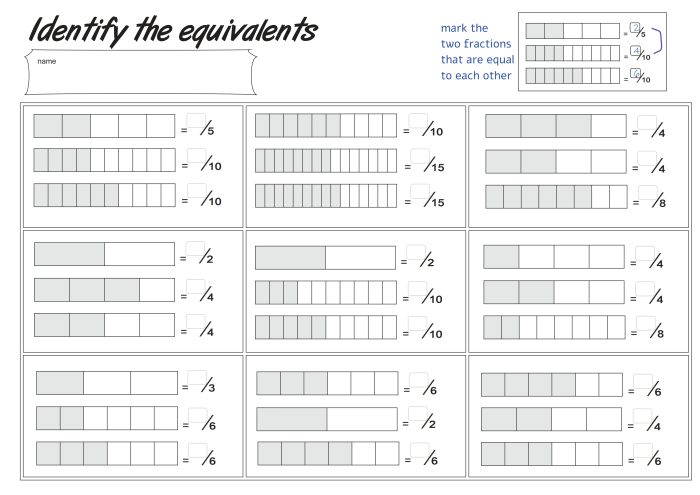
Furthermore, visual representation can enrich comprehension. When teaching or learning about equivalent fractions, employing pie charts or bar diagrams illustrates how different fractions represent the same quantity. Such visual aids can solidify one’s grasp of equivalence, particularly for those who may struggle with abstract numerical concepts.
In conclusion, the examination of the fraction 10/14 unveils a plethora of equivalent fractions. These include but are not limited to 5/7, 15/21, 20/28, and 25/35. By simplifying 10/14 and employing multiplication and visualization techniques, one cultivates a robust understanding of fractions and their interrelations. This knowledge not only serves as an essential tool in academic pursuits but also enhances one’s everyday mathematical proficiency. Recognizing the intricacies of fractions enriches not only mathematical understanding but also encourages a profound appreciation of the elegance underlying numerical relationships.

Leave a comment