

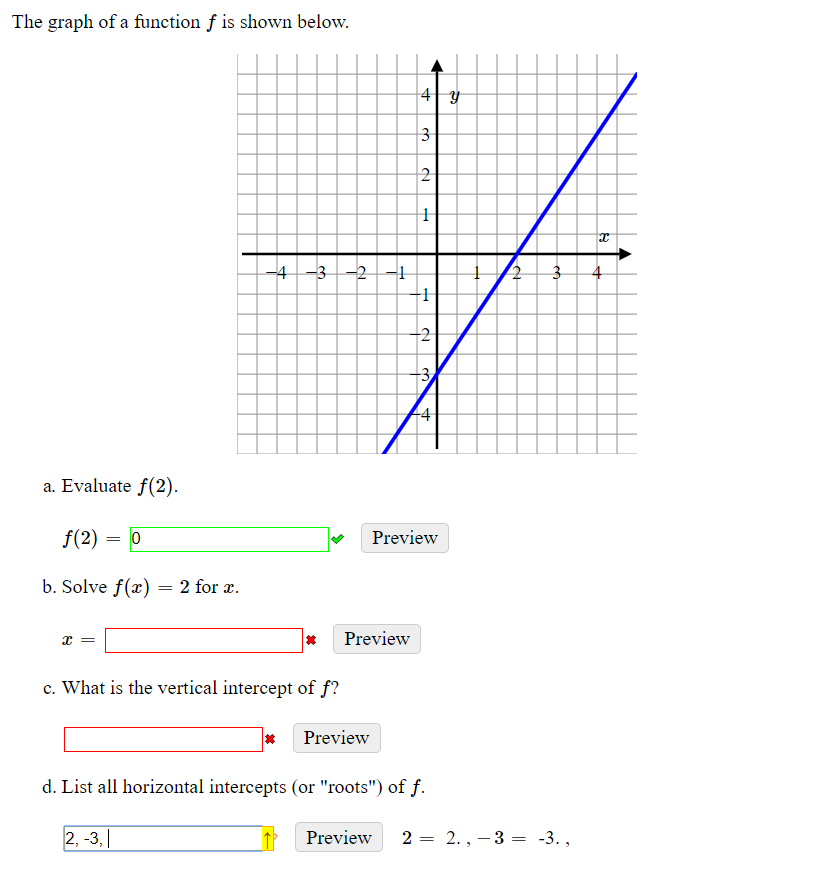
The exploration of mathematical functions, especially in graphical form, offers a wealth of insight into the underlying principles of algebra and calculus. The question, “Which function could be shown in the graph below?” demands a meticulous examination of the features typical of various mathematical functions. To appreciate the nuances of this inquiry, one must delve into comprehending not just the graphical representation itself, but the myriad types of functions available within the pantheon of mathematics.
At the outset, it is imperative to recognize the fundamental categories of functions: linear, quadratic, polynomial, exponential, logarithmic, trigonometric, and more. Each category exhibits distinct characteristics, allowing us to decipher and categorize a function based solely on its graphical representation.
1. Linear Functions
Linear functions are among the simplest and most foundational types of functions; they are represented by a straight line when graphed. The general form of a linear function is expressed as y = mx + b, where m denotes the slope and b signifies the y-intercept. If the graph exhibits a straight path, then it decidedly points toward linearity, illustrating a constant rate of change. The slopes may either be positive, negative, or zero, translating into an upward, downward, or flat graph respectively.
2. Quadratic Functions
Quadratic functions introduce a layer of complexity with their parabolic nature. Represented as y = ax^2 + bx + c, the graph’s characteristic U-shape can either open upwards or downwards, contingent upon the sign of a. Such functions reveal significant features, such as vertices and roots, which encapsulate critical information regarding their behavior and extremities. Observing whether the graph encompasses one or two intersections with the x-axis could discern whether real roots exist.
3. Higher Degree Polynomial Functions
Extending beyond quadratics, higher polynomial functions may present intricate curvatures and oscillations. Defined by the general form y = a_nx^n + a_{n-1}x^{n-1} + … + a_1x + a_0, these functions encapsulate a multitude of behaviors. Their degree essentially determines the number of potential x-intercepts and whether the graph showcases regions of local maxima or minima. As n escalates, the function’s complexity rises, offering a plethora of intersections and turning points.
4. Exponential Functions
Exponential functions, typified by equations such as y = ab^x (where a is a constant and b denotes the base), reveal fascinating growth patterns. Unlike polynomial functions, they are characterized by an accelerating increase or decrease, serving as a splendid representation of phenomena spanning finance to natural sciences. Observing the steepness of growth can vividly exhibit the nature of the function: rapidity in increase or decrease holds intrinsic significance in comprehending real-world applications.
5. Logarithmic Functions
The inverse of exponential functions, logarithmic functions unravel a different narrative. With expressions such as y = log_b(x), they exhibit a gradual ascent that plateaus over time. A graph with a notable rising curve that seems to flatten may very well signal a logarithmic nature, intricately tied to concepts of decay and resource depletion. Recognizing characteristics such as asymptotic behavior and intercepts can deepen one’s understanding.
6. Trigonometric Functions
When it comes to functions that exhibit periodic behavior, the sine and cosine functions emerge as quintessential examples. Exhibiting a repeatable wave pattern, these functions can provide insights into phenomena such as oscillations. Describing such a function involves recognizing essential attributes like amplitude and frequency, which define how high and how often the waves occur over a specified interval. The trigonometric identities transgress mere academic curiosity, finding application in various practical scenarios, such as engineering and physics.
7. Identifying the Function
To discern the nature of a given graph, one must engage in a systematic analysis of its cardinal features. The first step often involves scrutinizing intercepts—both x and y—as these provide initial clues regarding the function’s form. Next, the curvature, whether linear, parabolic, or oscillatory, assists in narrowing down the relevant categories. Observing the domain and range can also offer vital information, particularly in identifying restrictions or allowances present in the function. Notably, convexity and concavity can indicate polynomial versus rational identities, while inflection points might touch upon higher degree behavior.
Moreover, embracing a methodical approach goes hand in hand with recognizing potential transformations. Functions may undergo shifts, stretches, or compressions depending on their respective coefficients, thus altering their basic form significantly. Thus, understanding transformations can augment one’s capacity to decode and relate the function to its graph effectively.
In conclusion, the inquiry into “Which function could be shown in the graph below?” invites a thorough and engaging examination of the vast landscape of mathematical functions. By dissecting each category and identifying specific characteristics, one can dramatically shift their perspective, fostering a deeper curiosity about the relationship between graphical representation and its algebraic counterpart. This multilayered exploration elucidates not just the answer to the question at hand but also propels one toward a richer understanding of mathematical functions in their myriad forms.

Leave a comment