

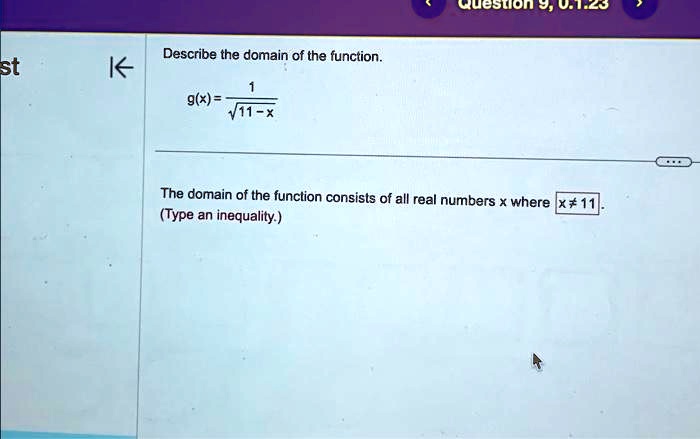
When contemplating mathematical functions, the concept of a domain often emerges as a fundamental aspect of their analysis. Domains specify the values that a function can accept, fundamentally shaping its application in various mathematical contexts. A particularly intriguing question arises when we consider which functions possess a domain defined as all x greater than or equal to negative eleven. This challenge invites us to explore a myriad of mathematical functions and to delineate their respective domains in relation to this criterion.
The domain of a function is indispensable; it sets the parameters within which the function operates. For a function to qualify as having the domain of x greater than or equal to negative eleven, it must include all real numbers starting from -11 and extending positively towards infinity. But what types of functions fit this rigorous specification? Let us traverse through several classes of functions, including linear, quadratic, and piecewise functions, that are either constrained to start at -11 or can be manipulated to align with the domain requirements.
First and foremost, consider the realm of linear functions. A linear function can be represented in the general form of f(x) = mx + b, where m denotes the slope and b signifies the y-intercept. To confine such a function to possess a domain of x ≥ -11, we can select an appropriate function such as f(x) = 2x + 10. Here, this function operates effectively for x values including -11 and greater, thereby satisfying the condition. The simplicity of linear functions foretells their broad accessibility; they are used across numerous disciplines, serving purposes ranging from basic arithmetic to advanced calculus.
Next, we delve into the captivating world of quadratic functions. Quadratic functions are typically represented by the standard form f(x) = ax² + bx + c, with a, b, and c being constants. A compelling example that honors our domain condition is f(x) = (x + 11)². This function effectively transforms any input that is equal to or greater than -11 into a non-negative output, thereby presenting a domain that not only satisfies the original requirement but also illustrates the parabola’s symmetric nature about its vertex. This vertex occurs precisely at the point (-11, 0), making it an exemplar of how quadratic functions can be cleverly manipulated to meet domain specifications.
Furthermore, let us consider piecewise functions that exhibit unique behavior dependent on the input value. An intriguing piecewise function could be defined as follows: f(x) = { x + 11, for x ≥ -11; undefined, for x < -11}. This structure allows the function to output valid values for all x greater than or equal to -11 while being undefined for lesser values. This approach invites creativity and complexity in constructing functions, showcasing the versatility of mathematics in accommodating varied scenarios.
Beyond these common function types, we should also contemplate the transcendental functions, which often present intriguing behaviors over their domains. For instance, we can take into account logarithmic functions. The function f(x) = ln(x + 11), while initially appearing somewhat deceptive, also abides by our requirements. The domain of the natural logarithm function mandates that its argument be positive. Thus, with ln(x + 11), the function only accepts x ≥ -11, confirming that it is indeed a valid candidate for our inquiry.
Moreover, one cannot overlook the impact and significance of rational functions. Consider the rational function f(x) = 1/(x + 11). Although it appears straightforward at first, it is critical to note that this function is specifically defined for values of x excluding -11, which would render the denominator zero. However, this can be addressed by slightly modifying the expression to produce a function that respects our domain, such as f(x) = 1/(x + 12) + 1, which would ultimately accommodate our domain requirement. Such nuances underscore the importance of thorough examination while analyzing function domains.
The interplay between various functions and their respective domains opens avenues for deeper exploration in mathematics. Functions can be creatively defined or adjusted to meet specific domain requirements. Whether through linear, quadratic, piecewise, transcendental, or rational function constructs, the mathematical world is replete with opportunity for innovative expression. Each function type provides unique perspectives and tools that can be mastered to provide solutions to complex problems.
In conclusion, the quest to identify functions whose domains encompass x greater than or equal to negative eleven is an illuminating venture into the more nuanced aspects of mathematics. As we have traversed through an array of function types, it becomes abundantly clear that the flexibility and creativity inherent within mathematical constructs allow one to adhere to domain stipulations. Whether it be through the linearity of straightforward functions or the complexities woven within piecewise definitions, the journey toward understanding how functions align with domain specifications is not only intellectually stimulating but serves as a reminder of the intricate tapestry that is mathematics.

Leave a comment