

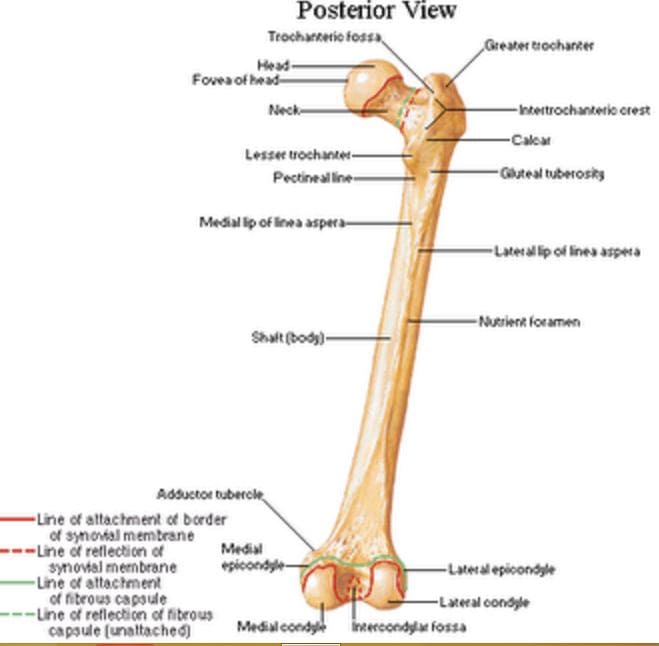
The term “Linea Aspera” refers to a prominent ridge found on the posterior aspect of the femur, the longest and strongest bone in the human body. This anatomical feature plays a critical role in the functional dynamics of the lower limb. Understanding the significance, location, and associated musculature of the linea aspera provides essential insight into femoral anatomy. This article will elucidate its relevance, discussing the bones featuring this distinctive line, and delve into its anatomical features.
The linea aspera serves as a crucial landmark along the femur and is delineated into two distinct parts: the medial and lateral lips. These two segments contribute to the attachment of various muscles and ligaments, facilitating movement and stabilization of the thigh. The linea aspera is particularly pronounced in humans, which underscores the evolutionary adaptations of our bipedal gait.
Firstly, let us examine the anatomy of the femur to contextualize the importance of the linea aspera. The femur comprises several key regions including the head, neck, and the trochanters, alongside the body where the linea aspera resides. It extends along the shaft of the femur, spanning from just distal to the greater trochanter to the supracondylar region, culminating near the distal ends of the bone. This anatomical arrangement allows for the effective attachment of muscles which play pivotal roles in leg movements.
Prominent muscles that attach along the linea aspera include the adductor group, which comprises the adductor longus, adductor brevis, and adductor magnus. These muscles are imperative for actions such as thigh adduction, flexion, and medial rotation, underlining the functional significance of the linea aspera. The insertion of these muscles allows for a greater surface area, promoting efficient and effective force generation during dynamic activities like walking, running, and jumping.
In tandem with the adductor group, other muscles such as the quadratus femoris and the vastus lateralis also owe their origin or insertion to the linea aspera. Their anatomical positioning along this line facilitates a synergistic relationship during physical activities, where power generation and stability are of utmost importance. The third vastus muscle, the vastus medialis, originates from the medial lip of the linea aspera and contributes significantly to knee extension and stabilization during ambulation.
The mechanics of the linea aspera extend beyond mere muscle attachment. It plays a part in the biomechanical characteristics of the femur. The curvature and orientation of the linea aspera contribute to the overall strength and load-bearing capacity of the femur, allowing it to withstand the forces exerted during motion. This property is particularly valuable in athletic contexts, where the stresses on the femur can be significantly higher.
The connective tissues surrounding the linea aspera, including fascia and various ligaments, further illustrate its anatomical importance. The lateral and medial intermuscular septa, which arise from the linea aspera, segregate adjacent muscle groups. This anatomical feature not only aids in isolating muscle compartments but also provides a pathway for vessels and nerves that supply the lower limb. Furthermore, the vascularization and innervation of muscles associated with the linea aspera underscore its importance in preserving effective communication between the muscles and the central nervous system.
In addition to muscles, the linea aspera is integral in providing attachment points for numerous ligaments. The strong fibers of the iliotibial tract that attach to the lateral aspect of the femur exemplify this, contributing to the stabilization of the knee joint during various activities, particularly in running and jumping scenarios. Such biomechanical interactions amplify the relevance of the linea aspera within the broader architectural complexity of human anatomy.
Interestingly, the morphological characteristics of the linea aspera can vary among individuals and across species. In particular, the prominence and definition of the linea aspera may differ based on factors such as age, sex, and physical activity levels. Notably, individuals engaged in rigorous physical training may exhibit a more robust linea aspera due to the enhanced muscular attachments. This variability presents significant implications for orthopedic assessments and surgical considerations.
Additionally, recognizing the pathological changes and injuries that can occur within the context of the linea aspera and its associated musculature is crucial for clinicians and healthcare professionals. Conditions such as adductor strain or tendinopathy in the vicinity of the linea aspera can lead to significant limitations in mobility and pain during activities. Therefore, understanding the anatomy and biomechanics of the linea aspera proves invaluable for the diagnostic process and the formulation of rehabilitation strategies.
In conclusion, the linea aspera, with its multifaceted role in the musculoskeletal hierarchy, embodies an essential element of femoral anatomy. By serving as an anchor point for critical muscle groups while contributing to the structural integrity of the femur, the linea aspera allows for sophisticated movements paramount to locomotion. Its significance extends from foundational biomechanics to therapeutic applications, underscoring the need for a comprehensive understanding of this anatomical feature within the field of medicine and sports science.

Leave a comment