

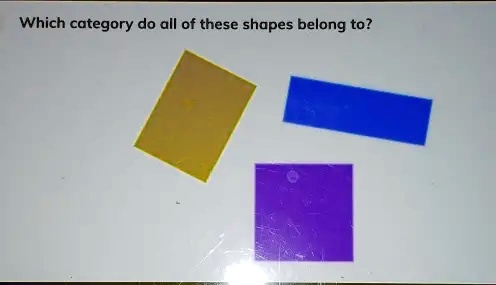
Geometry, an essential branch of mathematics, encapsulates a diverse array of shapes that evoke curiosity and intrigue. When confronted with various shapes, one might wonder about their commonalities. What unifying characteristic do they share? This question leads to a deeper exploration of geometric classification.
Shapes can be categorized in multifaceted manners, each revealing unique insights into their properties and applications. At the most fundamental level, shapes can be classified as either two-dimensional (2D) or three-dimensional (3D). Understanding these distinctions is crucial for paving the way toward more complex classifications.
Two-dimensional shapes, existing solely within a flat plane, include polygons and curves. Polygons are further distinguished by their sides and angles. Triangles, quadrilaterals, pentagons, and hexagons exemplify these categories. Each polygon is defined by the number of sides it possesses; for instance, a triangle boasts three sides, while a pentagon has five. This geometric lexicon, while straightforward, belies a wealth of sophistication in the study of spatial relationships.
Among polygons, triangles dominate both in prevalence and mathematical significance. They serve not only as the foundational building blocks of geometry but also as integral components in various applications, ranging from engineering to art. Triangles are classified based on their angles into acute, obtuse, and right triangles, showcasing a remarkable interplay between their form and the principles of Euclidean geometry.
Shifting our focus to three-dimensional figures, these shapes extend into the realm of volume and space. Common examples include spheres, cylinders, cones, and polyhedra. The complexity captured by these forms necessitates a more nuanced understanding of their properties, such as surface area and volume. For instance, the sphere, with its perfect symmetry, possesses an elegant simplicity that enshrines it as an object of fascination not only in mathematics but also in nature and art.
To categorize shapes comprehensively, we must delve into their inherent properties. One increasingly popular classification method is based on geometric symmetry. Symmetrical shapes, such as circles and regular polygons, exhibit invariance under certain transformations, such as rotation and reflection. This characteristic leads to a plethora of applications, including architectural design, pattern creation in textiles, and optimization in computational models.
Another vital classification is based on dimensionality and convexity versus concavity. Convex shapes, such as squares and rectangles, maintain their interior points when extended toward the edges, while concave shapes, like crescent moons or certain star polygons, possess indentations that complicate their properties. The contrast between these two categories prompts further inquiry into the relationships between shape, function, and form.
Examining real-world applications can elucidate why understanding these categories holds significant importance. Engineering relies heavily on an accurate understanding of shapes. The versatility of geometric principles can be seen in the architecture of bridges, buildings, and various structures, which demand a meticulous application of shape understanding to ensure safety and functionality.
Furthermore, the field of computer graphics employs geometric classifications to render images and animations. The representation of shapes as polygons and curves enables the creation of complex visual scenes and simulations. This intersection between geometry and technology continues to evolve, fostering advancements in virtual reality and interactive media.
Art and design also resonate with geometric concepts. Artists frequently utilize shapes to evoke emotions and provoke thought. The juxtaposition of different geometric forms can compel viewers to engage with the artwork on a deeper level, as shapes carry intrinsic meanings and associations grounded in cultural contexts.
To succinctly delineate the various categories into which shapes can be classified, consider the following:
- By Dimensionality:
- Two-Dimensional Shapes
- Three-Dimensional Shapes
- By Type:
- Polygons
- Curves
- Polyhedra
- By Symmetry:
- Symmetric Shapes
- Asymmetric Shapes
- By Convexity:
- Convex Shapes
- Concave Shapes
This classification schema serves to clarify the often intricate world of geometry. Each shape, whether simple or complex, adheres to specific rules and properties that govern its existence within the context of two-dimensional or three-dimensional space.
The fascination with shapes transcends mere numbers and measurements; it embodies a synthesis of art, science, and philosophy. From the elegance of a perfectly drawn circle to the intricate complexity of a fractal, the study of shapes encourages a lifelong journey of discovery. Understanding which category various shapes belong to not only enhances one’s geometric acumen but also enriches the appreciation of the world around us.
In summary, shapes, whether viewed through a mathematical lens or as artistic expressions, embody a universe of insight. Recognizing their categories enhances critical thinking and fosters creativity, as they intertwine in everyday life, technology, art, and nature. The journey through geometry is both an intellectual pursuit and a profound exploration of the intricacies of existence.

Leave a comment