

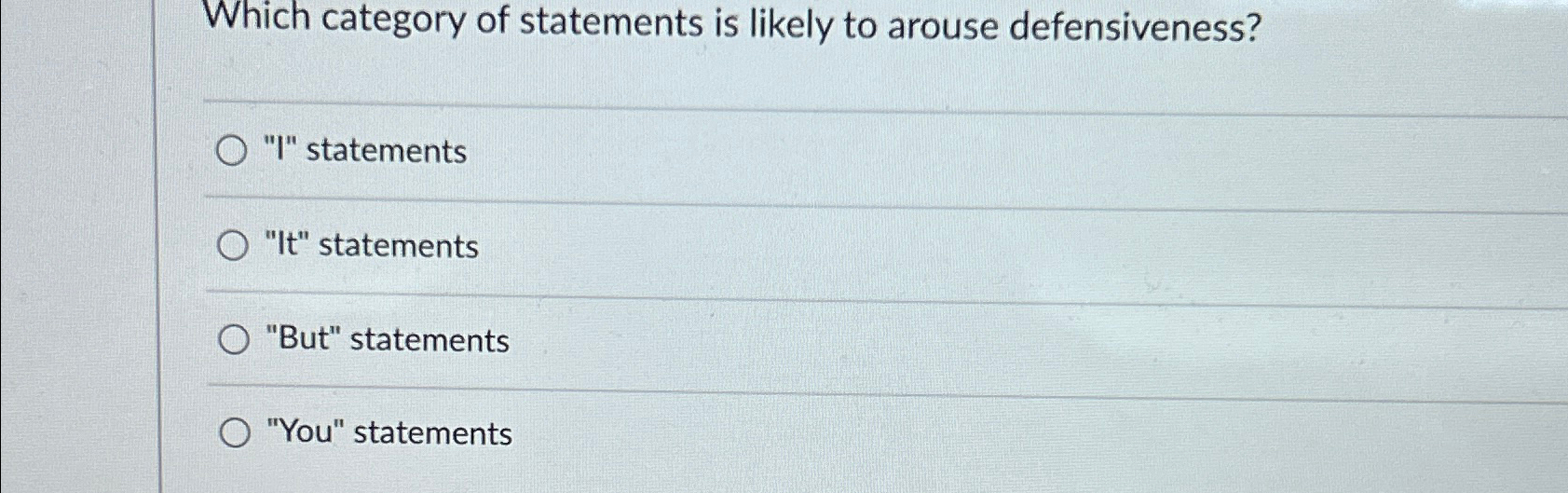
In the realm of psychology, the concept of defensiveness often emerges in discussions surrounding interpersonal communication and emotional responses. Understanding the categories of statements that provoke defensiveness can significantly enhance our ability to engage in constructive dialogues. Defensive reactions can stem from various sources, including perceived criticism, threats to ego, or challenges to personal beliefs. This article delineates the specific categories of statements that are likely to elicit such defensive attitudes, providing insights into their psychological ramifications.
1. Evaluative Statements
Evaluative statements are pervasive in everyday conversations, encapsulating judgments about someone’s behavior, character, or abilities. These statements typically include phrases such as “You always…” or “You never…” which often convey a judgmental tone. When an individual feels evaluated, particularly in a negative light, it can lead to an instinctive defensive posture. Such statements can be perceived as personal attacks, causing the recipient to feel cornered and subsequently react in a defensive manner. They represent an affront to one’s self-concept, often eliciting a desire to protect oneself from further critique.
2. Accusatory Statements
Accusatory statements, laden with allegations of wrongdoing or fault, are potent catalysts for defensiveness. These pronounced accusations can range from outright blame—”You are responsible for this mess”—to more subtle insinuations—”It seems like you didn’t care about my feelings.” In each instance, the recipient may feel compelled to negate their culpability, leading to a defensive response. The psychological underpinning here relates to the innate human proclivity to preserve a positive self-image. Thus, accusations are interpreted as direct threats to one’s integrity, invoking an emotional armor designed to deflect such assaults.
3. Prescriptive Statements
Prescriptive statements, which convey directives or commands, often generate defensiveness because they implicitly undermine autonomy. Phrases instructing someone on how to behave—”You should do this…” or “You need to stop…”—can incite feelings of resentment or resistance. When individuals perceive themselves as being controlled or manipulated, their instinctual reaction may be to assert their independence, manifesting as defensiveness. This dynamic illustrates the psychological tension between authority and autonomy. Even well-intentioned advice may trigger a counterproductive defensive response, distorting the intended message.
4. Generalizing Statements
Generalizing statements extend an individual’s specific actions to broad, sweeping conclusions about their character or intentions. Statements like “You always act selfishly” or “People like you…” can provoke defensiveness because they lack nuance and can feel overwhelmingly accurate to the recipient. The tendency to generalize can cause a person to feel painted into a corner, stripped of the individuality that defines their actions. Instead of fostering understanding, such blanket statements alienate the listener, compelling them to defend their actions by challenging the veracity of the generalization.
5. Comparison Statements
Comparison statements draw parallels between the individual in question and others, often highlighting perceived deficiencies. Examples include “Why can’t you be more like [name]?” or “Other people do this better.” Such comparisons are deeply detrimental as they trigger feelings of inadequacy and competition. The psychological impact of such statements can be profound, leading individuals to adopt a defensive stance as they strive to protect their self-worth. Instead of encouraging improvement, comparisons can instigate feelings of resentment and defeat.
6. Dismissive Statements
Dismissing someone’s thoughts, feelings, or contributions can evoke defensiveness by negating their emotional experiences or viewpoints. Statements such as “That’s not important” or “You’re overreacting” invalidate the individual’s feelings. The underlying psychology here reveals a fundamental need for validation in communication. When individuals feel dismissed, they may instinctively withdraw or react defensively in an attempt to reassert their value in the conversation. Defensive mechanisms, such as arguing or shutting down, can emerge as individuals struggle against the invalidation they perceive.
7. Unqualified Statements
Unqualified statements lack context or specificity and can make individuals feel misunderstood or misrepresented. Saying “You always mess things up” without acknowledging particular circumstances can belittle the complexities of a situation. This oversimplification can provoke defensiveness as it challenges the recipient’s perception of reality. The absence of qualifiers can lead to emotional turmoil, compelling the individual to defend their perspective vehemently. In essence, these statements often neglect individual circumstances, resulting in conflicts rather than resolution.
In conclusion, a nuanced understanding of the categories of statements that trigger defensiveness can significantly enhance interpersonal communications. By refraining from evaluative, accusatory, prescriptive, generalizing, comparison, dismissive, and unqualified statements, communicators can cultivate environments that foster openness and collaboration. Awareness of how language impacts emotional responses is paramount; it enables participants in a conversation to navigate disagreements with empathy and understanding. By adopting a more discerning approach to dialogue, we can mitigate defensive reactions and promote healthier, more productive exchanges.

Leave a comment