

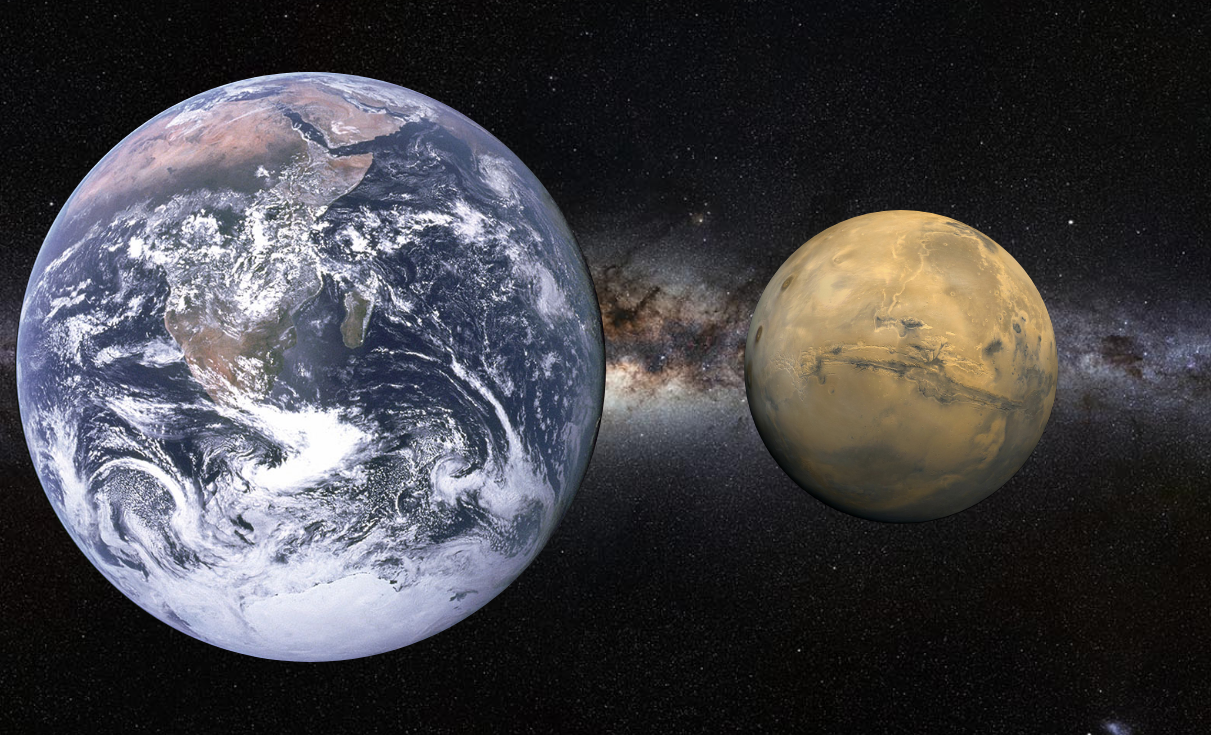
The vastness of the cosmos presents a plethora of celestial wonders, each exhibiting unique attributes that intrigue astronomers and enthusiasts alike. Among the many features manifesting throughout the universe, the ongoing quest to comprehend the scale of these cosmic entities is never-ending. In this discourse, we embark on a fascinating exploration, seeking to ascertain which celestial feature reigns supreme in terms of size. Prepare to shift your perspective as we delve into the various celestial objects that populate the expanse of space.
The universe is an intricate tapestry woven from galaxies, stars, planets, asteroids, and various other celestial phenomena. To determine which of these seems largest necessitates an examination of each category alongside a precise definition of “size.” When discussing size, we may consider diameter, mass, volume, or even luminosity, each yielding a different hierarchy of prominence.
Let us begin our examination with the most conspicuous entities on our cosmic stage: galaxies. Galaxies represent enormous structures composed of gas, dust, stars, and dark matter. The Milky Way, our home galaxy, encompasses roughly 100 to 400 billion stars and spans about 100,000 light-years in diameter. Yet, larger galaxies exist in the universe, such as IC 1101, located at the heart of the Abell 2029 galaxy cluster. This behemoth extends approximately 6 million light-years across, rendering it one of the largest galaxies known to humankind.
Transitioning from galaxies to individual celestial bodies, we encounter stars—nuclear furnaces that illuminate the cosmos. Among these, UY Scuti deserves a mention as one of the largest known stars, with an estimated radius nearly 1,700 times that of our Sun. However, when we contrast mass along with size, the designation can shift dramatically. The supermassive black hole at the center of the galaxy M87 garners attention, harboring a mass equivalent to approximately 6.5 billion solar masses, overshadowing typical stellar objects.
Next, we turn our observations toward planets, with an emphasis on gas giants, which dwarf terrestrial counterparts. Jupiter, the largest planet in our solar system, boasts a diameter of approximately 88,846 miles (142,984 kilometers), dominating in size. Yet, when venturing beyond our solar system, the search yields exoplanets like HD 100546 b, which may be larger than Jupiter, although our understanding remains incomplete due to the challenges of astronomical measurement.
Noteworthy also are the enormous structures that exist beyond individual celestial bodies, such as the cosmic web, representing the largest scale of cosmic structure. The universe’s large-scale structure consists of filaments and voids, forming a network that stretches across hundreds of millions of light-years. In this sense, one could argue that the most extensive feature is not a single entity, but rather the intricate arrangement of countless galaxies connected by gravity and dark matter.
Moreover, we must not overlook the potential for cosmic phenomena to manifest in even grander scales. The observable universe itself extends over 93 billion light-years in diameter, housing an estimated two trillion galaxies. From this vantage point, one could assert that the boundary of our observable realm is an unparalleled expanse that engenders both awe and philosophical reflection on our place within it.
Ultimately, determining which celestial feature holds the title of largest in actual size is contingent on the criteria applied. Is it the gargantuan galaxies that populate voids among the stars? Or perhaps the supermassive black holes lurking at their cores, embodying an unfathomable density? Each perspective invites an exhilarating inquiry, prompting further exploration into the nature of our universe.
This investigation into the size and scope of celestial features piques curiosity in ways that propel the human spirit toward further discovery. Our understanding of space grows richer not only through technological advancements in telescopes and detection methods but through the collective human endeavor to seek knowledge beyond familiar horizons. As we contemplate colossal entities like the Cosmic Microwave Background or the vastness of the intergalactic medium, the narrative of the universe unfolds, revealing layers upon layers of complexity.
The inquiry into size, mass, and luminosity reframes how we perceive our universe. The contemplation of realities existing beyond the bounds of human experience can evoke a profound appreciation for the mysterious and the magnificent. As we acknowledge these cosmic titans, we foster a deeper connection with the cosmos and affirm our shared quest for understanding—reflecting humanity’s innate drive to explore the unknown and to comprehend the grandeur that resides amongst the stars.
In conclusion, as we gauge the sizes of various celestial features, the complexity of categorization becomes evident. The lacuna of knowledge surrounding the universe offers a canvas for curiosity, exploration, and intellectual engagement. As we continue to advance our understanding of the universe, may we always hold, in some measure, the wonderment that arises when gazing into the infinite night sky.

Leave a comment