

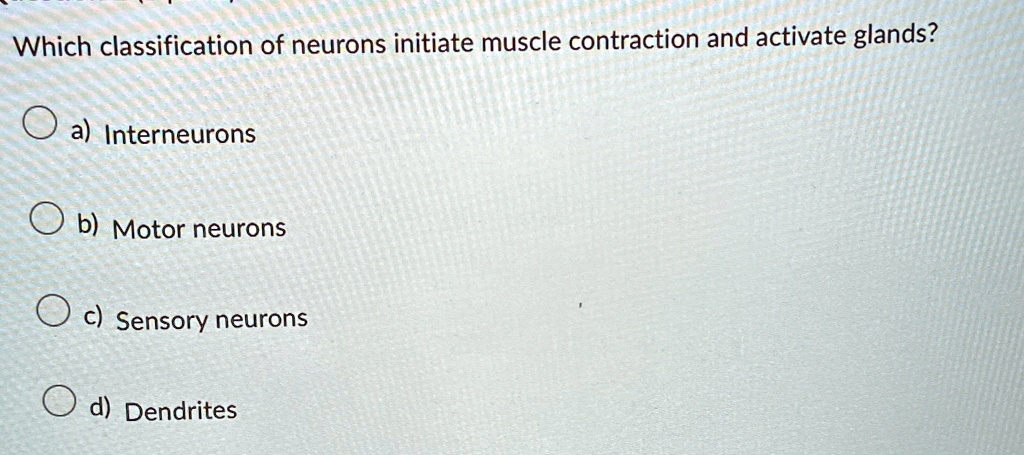
In the intricate realm of neuroscience, the classification of neurons is pivotal in understanding how our body mobilizes and responds to stimuli. Neurons play a crucial role in initiating muscle contraction and activating glands. This article delves into the various classifications of neurons, heavily emphasizing those specifically implicated in these motor functions.
Neurons can primarily be classified into three categories: sensory neurons, motor neurons, and interneurons. Each type possesses distinct functions and mechanisms but converges within the neuromuscular and neuroendocrine connections critical for muscle contraction and glandular activation.
1. Sensory Neurons
Sensory neurons, often referred to as afferent neurons, transmit signals from sensory receptors to the central nervous system (CNS). These neurons play a vital role in collecting data from the environment, such as touch, vision, and sound. Although they do not directly cause muscle contractions or activate glands, they are fundamental in relaying the information needed for these processes to occur.
For instance, when a stimulus is detected, sensory neurons convey this information to spinal cord and brain areas, where an appropriate motor response can be coordinated. The role of these neurons is immensely underappreciated; they act as the lead-up to the more direct actions of motor neurons.
2. Motor Neurons: The Architects of Movement
Motor neurons can be further subdivided into two primary classifications: upper motor neurons and lower motor neurons. Upper motor neurons originate in the brain and transmit impulses to lower motor neurons in the spinal cord. Their roles are pivotal in the planning, control, and execution of voluntary movements.
Lower motor neurons, which directly innervate skeletal muscles, are the true instigators of muscle contraction. Upon receiving stimuli from upper motor neurons, these neurons project their axons to muscle fibers, releasing neurotransmitters such as acetylcholine at the neuromuscular junction. This interaction leads to the muscle fibers’ contraction, effectively facilitating movement. Without lower motor neurons, voluntary muscle control would be impossible.
In addition to controlling skeletal muscles, lower motor neurons also play a role in reflex arcs. Reflexes are rapid, involuntary responses to specific stimuli, allowing immediate reactions. This elegance in function underscores the lower motor neurons’ capability in both complex and simple forms of muscle activation.
3. Interneurons: Integration and Coordination
Interneurons serve as the intermediary between sensory and motor neurons. Their existence is mostly confined within the CNS, where they perform complex integrative functions. Interneurons are of various types and can be excitatory or inhibitory in their effects on adjacent neurons, thus significantly influencing the output of motor neurons.
By processing sensory inputs and modulating signals passed onto motor neurons, interneurons enhance the coordination of muscle contractions. For example, during a voluntary movement, visual and tactile information processed by sensory neurons can be rapidly integrated through the action of interneurons before a motor response is executed.
4. The Role of the Autonomic Nervous System
In addition to the somatic motor pathways discussed, it is imperative to recognize the role of the autonomic nervous system (ANS) in muscle and glandular activity. The ANS governs involuntary functions, including the activity of smooth muscle and glands. Sympathetic and parasympathetic divisions of the ANS modulate the activity of internal organs by connecting to various types of motor neurons.
The sympathetic division prepares the body for ‘fight or flight’ responses, effectively increasing heart rate and redistributing blood flow away from non-essential functions towards skeletal muscles. Conversely, the parasympathetic division restores the ‘rest and digest’ state post-stress, enhancing glandular secretions and promoting muscle relaxation. This dynamic interplay emphasizes the neurons’ broader spectrum in both voluntary and involuntary processes.
5. Neurotransmitters and Their Function
Neurotransmitters are the chemicals that facilitate communication between neurons. Acetylcholine, for instance, is crucial in the neuromuscular junction, where it binds to receptors on muscle fibers, initiating contraction. Other neurotransmitters, including glutamate and gamma-aminobutyric acid (GABA), play roles in excitatory and inhibitory actions within the motor pathways, respectively. The proper balance and functioning of these neurotransmitters are essential for coherent muscular engagement.
Moreover, neuromodulators, such as dopamine and serotonin, can influence motor neuron activity, thereby affecting movement and coordination, adding layers of complexity to neuronal classification and functionality.
Conclusion
The classification of neurons is an intricate tapestry woven with multiple threads of functionality, comprising sensory neurons, motor neurons, and interneurons. Motor neurons are the primary agents of muscle contraction, while interneurons provide necessary coordination and regulatory actions. The autonomic functions governed by the neuronal network expand our understanding beyond mere skeletal muscle control to include visceral responses, highlighting the elaborate design of the nervous system. An appreciation of these classifications is crucial not only for academic pursuits but also for advancements in medical and therapeutic interventions targeting neuromuscular disorders.

Leave a comment