

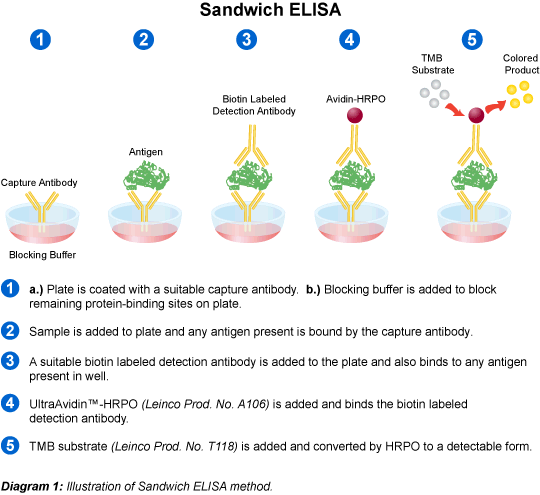
Sandwich ELISA, or Enzyme-Linked Immunosorbent Assay, is a sophisticated laboratory technique that employs the principles of immunology to detect and quantify specific antigens. This method stands out as a confluence of biological affinities, akin to a well-choreographed dance wherein each dancer must find their perfect partner. To comprehend which components of this elegant assay are essential in pairs, one must delve into the nuances of its architecture.
The cornerstone of the Sandwich ELISA methodology consists of two types of antibodies: capture antibodies and detection antibodies. Each plays a critical role, much like the left and right hand of a skilled craftsman, working synaptically to achieve a precise outcome. Let’s explore these components in detail, illuminating their indispensable partnership.
1. The Capture Antibody: Setting the Stage
The initial phase of a Sandwich ELISA involves the utilization of a capture antibody, which is immobilized on the wells of a microplate. This phase is akin to laying the first stone in a grand architectural design, establishing the foundation upon which the subsequent layers will be constructed. The capture antibody is specifically selected to bind to the target antigen. This specificity is vital; the capture antibody must recognize and adhere to an epitope on the antigen without ambiguity.
Upon the introduction of the sample containing the antigen, a crucial interaction takes place. The antigen, if present, will bind to the immobilized capture antibody, forming a stable complex. This foundational union is quintessential, as it secures the antigen for further analysis. However, like a novel that requires multiple perspectives, the capture antibody alone cannot provide a complete narrative. It necessitates the subsequent presence of a companion: the detection antibody.
2. The Detection Antibody: The Counterpart that Complements
Enter the detection antibody, the essential duo’s other half. Once the antigen is captured and fixed in place, the detection antibody is introduced, and its role is to reinforce the findings. This antibody is typically linked to an enzyme or a detectable label, which acts like a spotlight illuminating the initial capture. The detection antibody binds to a separate epitope on the already anchored antigen, akin to a second dancer who, upon joining the first, creates a more intricate and visually compelling performance.
The link between detection antibody and enzyme is critical. The enzyme, upon adding a substrate, catalyzes a reaction that prompts a measurable signal, such as a color change or fluorescence. This transformation marks the culmination of the assay, where the original binding events are translated into quantifiable data. It illustrates an essential point: without the detection antibody, the entire assay remains an unlit stage, devoid of any discernible action.
3. The Importance of Specificity and Affinity
The compelling success of Sandwich ELISA relies not only on the dichotomy of the capture and detection antibodies but also on their specificity and affinity for the antigen. High-affinity interactions ensure that the antibodies claim their respective targets with certainty. Imagine a lock and key creation; the unique contours of the key (antibody) must align perfectly within the lock (antigen) to facilitate entry. This precise binding ensures accuracy and reduces the likelihood of false positives or missed detections, thereby bolstering the method’s robustness.
4. The Role of Standards and Controls
Fostering an unblemished environment for these pair partners is equally paramount. Calibration involves the integration of standards and controls into the assay design. Standards provide a reference point, akin to a metronome guiding the rhythm of a symphony, ensuring that the results can be interpreted accurately. Meanwhile, controls act as the safety net, confirming that the assay is functioning as intended. Their interaction with capture and detection antibodies further attests to the validity and reliability of the results.
5. Conclusion: The Dance of Antibodies
In summary, the intricate ballet of the Sandwich ELISA highlights the indispensable need for both capture and detection antibodies to be employed in pairs. Each component plays a critical role, establishing a framework that transforms the presence of an antigen into measurable outputs. The harmonious interplay of these antibodies ensures specificity, facilitates quantification, and ultimately serves as a powerful tool in both research and clinical diagnostics.
Understanding this pairing illuminates the artistry of immunological testing. As scientists continue to innovate within this realm, the metaphor of the dance remains ever relevant; the essential partnership of the antibodies dances through the laboratory, revealing the unseen with grace and precision. Indeed, in the world of immunology, every component has its partner, highlighting the beauty inherent in scientific collaboration.

Leave a comment