

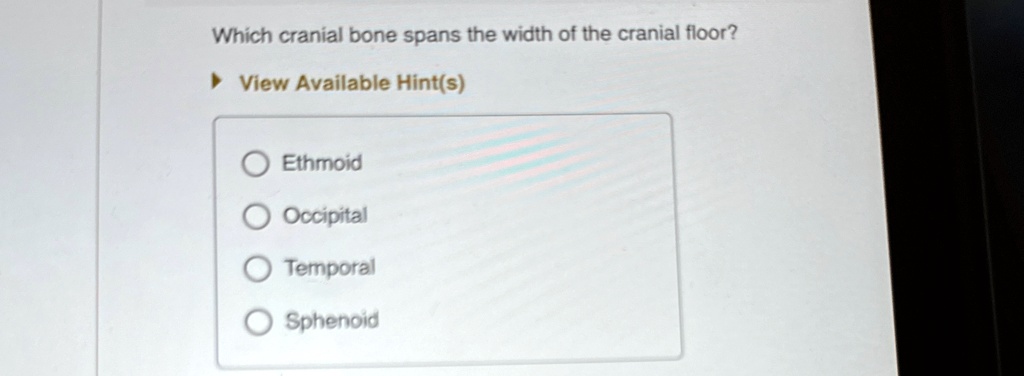
The intricate architecture of the human skull, which serves as a protective casing for the brain, harbors a fascinating array of cranial bones, each with distinct features and roles. Among these bones, one stands out for its unique spatial orientation and structural function—the **sphenoid bone**. This article elucidates the characteristics and significance of the sphenoid bone, particularly its role in spanning the width of the cranial floor.
The sphenoid bone is often described as a keystone of the cranial floor, comparable to how a keystone in an arch holds other stones in place. Positioned centrally within the cranial cavity, it interlinks with several cranial and facial bones, establishing a pivotal connection between the anterior and posterior aspects of the skull. This bone’s unique butterfly-like shape and extensive articulation with other bones vividly demonstrate its complexity and the fantastical nature of human anatomy.
At first glance, one might observe the sphenoid bone as merely a complex structure intertwined with its neighbors. However, upon deeper investigation, we can appreciate its multifaceted contributions to both the architecture of the cranial cavity and the functionality of the surrounding anatomical structures. The sphenoid’s two pairs of wings, known as the greater and lesser wings, and its prominent sella turcica, which houses the pituitary gland, exemplify its critical role in housing and protecting essential neurological components.
The greater wings of the sphenoid bone extend laterally, articulating with the temporal and parietal bones, effectively bridging the cranial cavity with the orbits of the eyes. From a lateral view, the expansive breadth of these wings can be observed, creating an impression of support that reinforces the cranial vault. This anatomical configuration not only highlights the sphenoid’s role in providing structural integrity to the skull but also augments its role in protecting vital neurovascular structures.
Moreover, the sphenoid bone features several important foramina (openings), which facilitate the passage of cranial nerves and blood vessels. For instance, the optic canal allows for the optic nerve to traverse from the orbit to the brain, thus playing a pivotal role in visual perception. Additionally, the superior orbital fissure traverses the greater wing, permitting the conveyance of ocular and motor nerves that control eye movement. These features exemplify the sphenoid’s dual role as both a protective barrier and a conduit for essential neural pathways.
Another significant aspect of the sphenoid bone involves its articulation with neighboring cranial bones. It articulates with fourteen different bones, a feature that emphasizes its central positioning and functional importance within the cranial anatomy. This articulation enhances the overall stability of the skull while permitting a degree of mobility necessary for various physiological functions. Such multifactorial relationships underscore the sphenoid’s role as more than just a passive participant in cranial architecture—it is a dynamic component essential for maintaining the integrity and functionality of the cranial cavity.
The unique morphology of the sphenoid bone provides further insights into its fascinating role. The body of the bone houses the sphenoidal sinus, which contributes to the nasal cavity’s ventilation and serves in voice resonance. It is intriguing to consider how this single bone houses various spaces that serve different purposes—be it protection, support, or even sound modulation. Such versatility within a singular anatomical structure is a testament to the evolutionary sophistication of human anatomy.
The sphenoid bone’s position also holds significance beyond mere structural analysis. It acts as a critical landmark in cranial surgery, guiding neurosurgeons and otolaryngologists during procedures that require access to the base of the skull. Understanding its location and relationship to surrounding structures is essential for interventions involving the pituitary gland, cranial nerves, or vascular components. The intricate relationships embodied in its anatomy offer a deep sense of respect for both the challenges and triumphs of medical science when interfacing with such a delicate and essential area of human physiology.
Furthermore, from an anthropological perspective, variations in the shape and size of the sphenoid bone among different populations warrant inquiry. Such differences may unveil insights into evolutionary adaptations or the adaptations to environmental factors. The exploration of these dimensions leads to intriguing discussions regarding the interplay between anatomy and genetics, ultimately enriching our understanding of human diversity.
In summary, the examination of the sphenoid bone reveals a rich tapestry of anatomical features and functional importance. Its capacity to span the width of the cranial floor is not merely a structural characteristic; it symbolizes the intricate unity of form and function within the human body. To appreciate the sphenoid bone is to engage with the deeper wonders of anatomy—a field where every bone tells a story, and every articulation hints at a greater purpose. As we explore these complexities, we uncover a profound connection between ourselves and the remarkable design of our biological framework.

Leave a comment