

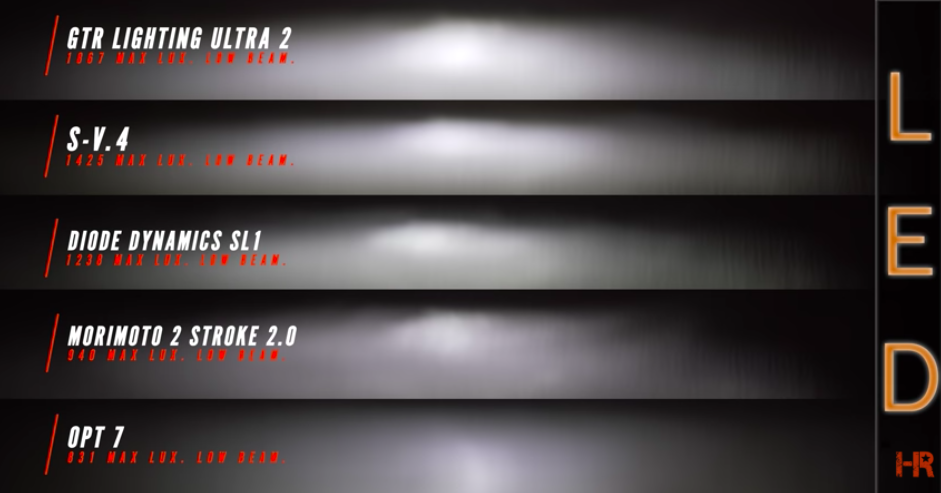
In the modern era of illumination, two titans of lighting technology stand atop the spectrum: High-Intensity Discharge (HID) lamps and Light Emitting Diodes (LEDs). Each possesses distinct attributes and a unique sheen, igniting debates among enthusiasts and professionals alike regarding their respective brilliance. Which of these lighting luminaries truly shines the brightest? This disquisition seeks to explore the intricacies of these two technologies, weighing their luminosity against a backdrop of other practical attributes, to elucidate their respective places in the pantheon of illumination.
To commence this exploration, one must first unravel the fundamental principles of light generation in HID and LED technologies. HID lighting produces light through an electrical arc between two electrodes encased within a gas-filled chamber. It is akin to a celestial explosion, harnessing the power of an electric arc to illuminate the surrounding environment. Meanwhile, LEDs employ a markedly different methodology, generating light through electroluminescence—a process that happens when electrons recombine with holes within a semiconductor material, emitting photons in the process. This technology is similar to a more subdued firefly, quietly exuding light rather than exploding forth like the stars.
When discussing luminosity, the term “brightness” transcends mere light output. It includes metrics such as color temperature, lumens, and the efficacy of energy consumption. Measured in lumens, the light output of HID lamps can reach up to 110 lumens per watt, giving them an audacious edge in various applications such as automotive headlights and high-intensity arena lighting. For instance, a 300-watt metal halide HID lamp can emit approximately 30,000 lumens, illuminating expansive spaces with a high level of intensity, often used in stadiums and outdoor settings.
Conversely, LEDs have seen staggering advancements in their luminosity over the past few decades. Initially, their output was modest; however, modern iterations boast up to 160 lumens per watt or more, showcasing their remarkable efficiency. The efficacy of an LED bulb not only allows it to compete with HID counterparts in brightness, but it also offers superior longevity, often reaching upwards of 50,000 to 100,000 hours— an enigmatic promise that traditional HID systems find hard to match. The durability factor of LEDs is akin to a resolute oak tree, standing strong against the test of time, while HID lamps resemble a fleeting blossom, often needing replacement every 15,000 hours, depending on usage.
However, brightness is but one thread in the intricate tapestry of lighting technology. Color temperature, measured in Kelvins, plays a pivotal role in the perception of brightness and ambience. HID lights often emit a cooler color temperature, which can range between 3000K to an icy 6000K. This can result in a strong, bluish tint, creating a stark and urgent atmosphere suited for industrial applications. In contrast, LEDs offer a rich palette, from warm, inviting tones of 2700K to the crisp, clinical tones of 6500K. The option to select the desired hue imbues users with agency, echoing the choice of a painter selecting colors on a palette, thus rendering LEDs more versatile for residential settings.
Furthermore, the environmental implications of these technologies warrant consideration. HID lamps, despite their high lumen output, operate with relatively lower energy efficiency, and their longer warm-up time can be a drawback for certain applications. Additionally, the potential for harmful chemicals, such as mercury in some HID bulbs, raises concerns regarding environmental safety and waste. In contrast, LEDs are celebrated as eco-friendly paragons, free from toxic materials and favoring recyclability when the inevitable end-of-life phase arrives for the bulb. This aspect elevates LEDs beyond a mere lighting source; they emerge as stewards of green technology, harmonizing human needs with ecological responsibility.
The cost implications associated with these technologies also merit exploration. While the upfront investment for HID installations might be less, especially in contexts like commercial spaces, the ongoing costs of maintenance and electricity consumption can cumulatively surpass those of LED systems, which boast noticeably lower operational costs in the long run. The adage, “buy nice or buy twice,” comes to mind, encouraging investors to consider long-term savings that LEDs gracefully provide.
As we thread through the comparative litany of performance, versatility, and environmental impact, one can see that the battle between LEDs and HIDs is not merely one of brightness but of contextual suitability. Anticipating the application’s requirements—be it for a bustling stadium, a serene home setting, or an environmentally conscious project—will ultimately guide the decision-making process. LEDs exhibit remarkable prowess in energy efficiency and longevity, while HIDs retain certain advantages in high-intensity scenarios, such as street lighting and automotive applications.
In conclusion, while both LED and HID lighting technologies possess their individual brilliance, the optimal choice depends on the specific requirements and overarching context of each application. As we stride into a future fraught with ever-advancing technologies, understanding the nuanced differences between these lighting giants will illuminate the path forward, ensuring that we can harness their unique virtues to enhance our environments with clarity and purpose.

Leave a comment