

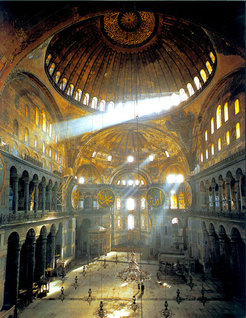
The Hagia Sophia, an edifice that defies the ordinary, stands as a monumental testament to architectural ingenuity and engineering prowess. Its dome, an epitome of spatial elegance, floats above the congregation as though held aloft by celestial hands. To comprehend the architectural components that lend support to this marvel is to glimpse into the synthesis of innovative design and traditional methodologies that characterize Byzantine architecture. Such an exploration reveals not merely the mechanics of support but also the profound philosophical underpinnings that informed its creation.
At the heart of this architectural wonder lies the dome itself—an expansive structure crowned with a ring of light that dimly illuminates the ornate interior. The diameter of the dome measures an astounding 31 meters, creating a vast expanse that commands attention and creates a sense of transcendence. But what lies beneath the surface and supports this massive weight? The answer is as intricate as the design itself—an array of components that collectively form a cohesive whole.
First and foremost, the primary supporting elements of the dome are the massive piers found at each corner of the square base. These towering structures are not mere columns; they are the very bedrock upon which the dome rests. Erected of brick and mortar, the piers possess a formidable strength, allowing them to bear the immense weight of the dome while sculpting the vertical experience of the church’s interior. Each pier is designed to transfer the dome’s weight down to the building’s foundation, converting the forces of gravity into a harmonious celebration of balance.
In conjunction with the piers, the archways play a pivotal role in the support system of the dome. The Hagia Sophia employs a series of semi-domes and arches, which act as connectors between the central dome and the supporting piers. These arches are not solely functional; they serve as aesthetic conduits, guiding the eye towards the magnificent dome while creating an ethereal rhythm within the architectural composition. The interplay of light and shadow cast upon the arches contributes to a divine ambiance, further enhancing the spiritual experience of the space.
Moreover, the inclusion of buttresses cannot be overlooked. These structural elements extend from the supporting walls, providing lateral stability to the dome while defending against the forces that threaten to topple its delicate balance. The buttresses work silently, often unnoticed, yet they are as essential as the piers and arches. They reinforce the integrity of the edifice as a whole, creating a fabric of support that renders the monumental dome an eternal fixture of the skyline.
As we venture further into the layers of support, we encounter the intriguing phenomenon of pendentives. These ingenious architectural devices bridge the transition from the square base to the circular dome. The use of pendentives is particularly noteworthy in its ability to facilitate the harmonious union of different geometries. Rather than stark corners, they allow the dome to emerge organically from the structural base, echoing the very principles of continuity and evolution in design. The pendentives serve as a metaphorical tapestry, weaving together the diverse elements of form and function. In doing so, they transform the otherwise static supports into dynamic contributors to the architectural narrative.
Furthermore, the use of light in the design amplifies the structural support’s aesthetic significance. The Hagia Sophia’s numerous windows embellish the dome’s base, permitting rays of divine illumination to flood the interior. This symbiosis of light and structure not only contributes to the visual appeal but also asserts the dome’s metaphorical elevation toward the heavens. It’s as if the building itself is a conduit between the earthly realm and the divine, with each supporting element cumulatively enhancing this facet of the structure.
The innovative deployment of materials further buttresses the dome’s grandeur. The Byzantine architects exhibited a discerning choice in utilizing lightweight materials such as bricks and pumice, which reduce the overall load on the supporting structures. This thoughtful selection reveals an acute understanding of material properties balanced with the overarching need for durability. Thus, the fusion of artistic expression with adept engineering methodologies culminates in a structure that can withstand the ravages of time while still rendering its splendor amidst an ever-changing world.
Additionally, the significance of the Hagia Sophia transcends mere architectural accolades; it distinguishes itself as a symbol of cultural convergence and moral integrity. The dome, with its myriad supporting components, stands not just as a physical entity, but as an emblem of resilience and continuity. Each time one gazes upward into the vast canopy, he or she is reminded of the interconnectedness of form and function, the embodiment of eternity framed within walls of stone.
In conclusion, the Hagia Sophia rises beyond the conventional definitions of architecture. The dome, masterfully supported by piers, arches, buttresses, and pendentives, encapsulates a philosophy that places equal emphasis on strength and beauty. In this grand creation, the supporting components do not merely hold the dome in place; they articulate a story of innovation, cultural exchange, and human aspiration. As the sun beams down on this engineering marvel, it shines not only on a structure of stone but illuminates the rich tapestry of human endeavor that created it. Through the lens of architectural excellence, the Hagia Sophia invites all who enter to revel in its breathtaking harmony—a sanctuary where support is more than structural, but fundamentally woven into the very fabric of existence itself.

Leave a comment