

Participles, those intriguing verbal forms that allow us to create a rich tapestry of language, often spark curiosity ranging from their function to their application. This exploration invites you to ponder: What makes participles so captivating? Are they merely grammatical tools, or do they have an aesthetic value that enriches our discourse? Let’s delve into the multifaceted world of participles, illuminating the rules and considerations that define them.
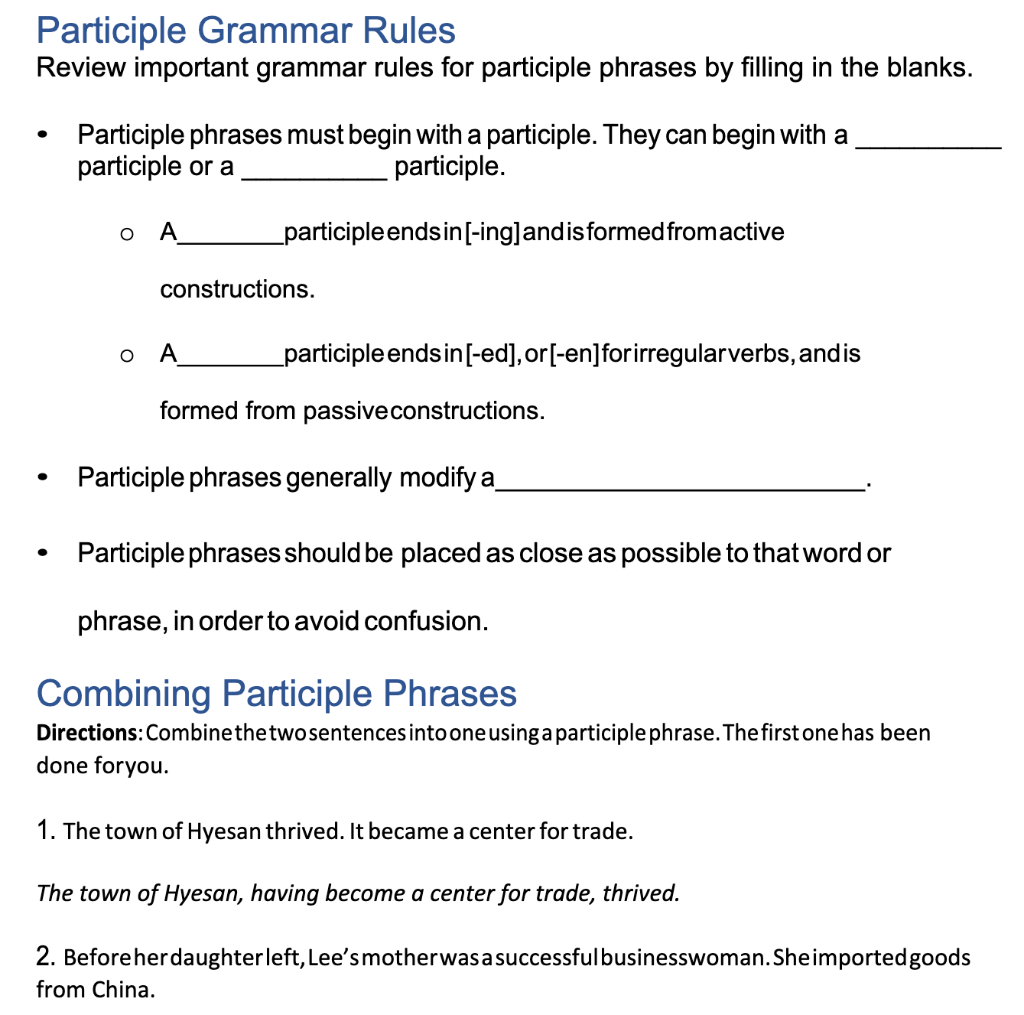
In the realm of grammar, participles assume two primary forms: the present participle and the past participle. Understanding the distinctions between these forms is essential in grasping their usage in varied contexts. Present participles, those ending in “-ing,” are often utilized to convey ongoing actions or states. In contrast, past participles typically conclude with “-ed,” “-en,” or other irregular forms and serve to denote completed actions. Such definitions are foundational; however, the full potential of participles unfolds as we examine their syntactic roles.
Firstly, participles can function as adjectives, modifying nouns and pronouns in a sentence. For instance, consider the phrase “the running water.” Here, “running” vividly describes a characteristic of the water, imparting a sense of motion and liveliness. Conversely, in “the broken vase,” the participle “broken” provides a crucial detail about the state of the vase, eliciting an emotional response from the audience. Therefore, it is imperative to recognize how participles can breathe life into language, introducing nuance and specificity.
Moreover, participles can also lead to the formation of participial phrases, wherein they are accompanied by modifiers or complements. Such structures enhance sentence fluidity and complexity. For instance, in the sentence, “Eager to impress, the student submitted his essay early,” the phrase “Eager to impress” acts as a tantalizing entry point to the main clause, establishing context and engaging the reader. Thus, the craft of participial phrases can captivate one’s audience, underscoring the importance of participles beyond their mere grammatical categorization.
Another pivotal aspect is the notion of dangling participles—an issue that can lead to ambiguity and misinterpretation. A dangling participle occurs when the subject intended to be modified is either absent from the sentence or appears in a different context, leading to confusion. For example, “Running down the street, the birds caught my attention” suggests that the birds were running, which is not the intended meaning. Instead, restructuring the sentence to clarify the subject will restore coherence: “Running down the street, I caught the attention of the birds.” Thus, awareness of dangling participles is crucial for clear communication.
Participles also play a significant role in constructing perfect verb tenses. The past participle is used alongside auxiliary verbs such as “have” or “had” to indicate actions that are completed relative to another timeline. For instance, “She had finished her homework before dinner” demonstrates the use of the past participle to establish the sequence of events chronologically. Understanding how participles operate within perfect tenses enriches one’s grasp of timeline nuances, enabling more sophisticated writing.
Additionally, it is important to recognize the stylistic choices afforded by participles. Skilled writers often employ participial constructions for varying sentence rhythm and presentation. Short, declarative sentences can quickly convey straightforward ideas, but the incorporation of participles introduces complexity and variation, capturing readers’ interests. Imagine writing, “The sun set, painting the sky in hues of orange and pink,” where the participial phrase elegantly paints a visual tableau. Here, the participle “painting” not only modifies the action but also enhances the imagery, affording the sentence a lyrical quality.
However, practitioners of grammar must also grapple with the irregularities associated with past participles. English, with its eclectic origins, presents several irregular verbs that defy typical conjugation patterns. Consider the verb “to go,” which takes the past participial form “gone.” In contexts such as “She has gone to the market,” the irregularity necessitates memorization and application, showcasing the intricacies embedded within the language structure. This complexity can pose a challenge, yet it also highlights the vibrancy of the English language.
In summary, participles are not merely grammatical constructs; they represent an intricate interplay of form, function, and style. They can operate as adjectives, form phrases that enrich narrative depth, affect the clarity of writing, facilitate perfect tenses, and imbue prose with artistic flair. Awareness of their roles—including the pitfalls presented by dangling participles and the challenges posed by irregular forms—enables writers to wield participles with confidence and creativity.
As you navigate the landscape of participles, take a moment to consider: Do you treat them merely as grammatical necessities, or do you embrace their potential to sculpt your written expression? The challenge lies in understanding their multifarious applications and leveraging them to enhance your communicative prowess. In mastering the art of participles, you unlock a powerful chord in the symphony of language.

Leave a comment