

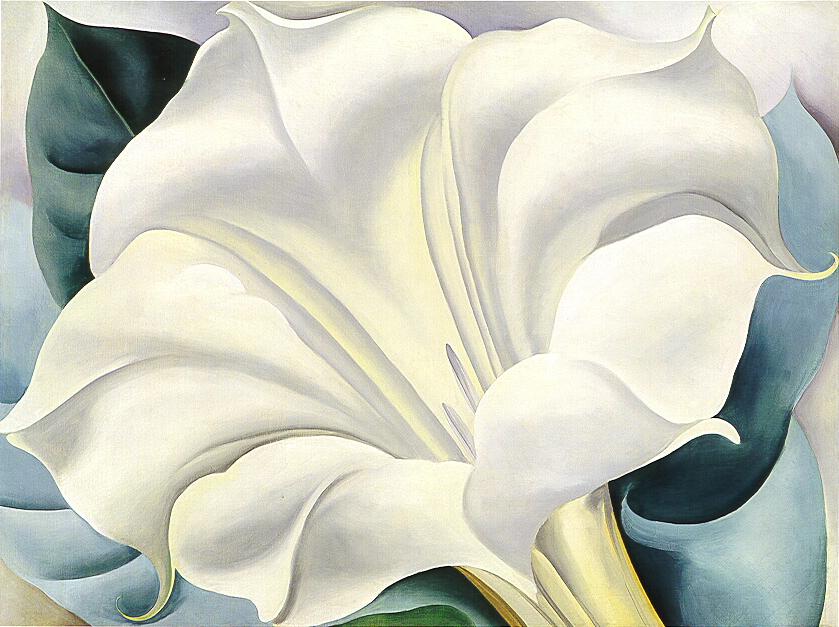
In the rich tapestry of art history, the movement of Organic Modernism stands out for its emphasis on the natural rhythms present in the environment, particularly the delicate yet profound essence of flowers. Organic Modernism emerged in the early to mid-20th century, distinguished by its philosophical grounding in embracing natural forms, rhythms, and organic characteristics. Several artists have adeptly woven this thematic focus into their works, but few have exemplified this ethos as deeply as Georgia O’Keeffe. This exploration delineates O’Keeffe’s approach, her influences, her distinctive style, and the broader context of Organic Modernism.
Georgia O’Keeffe, often hailed as the “Mother of American Modernism,” transcended traditional representations through her innovative use of color, form, and composition. Her artistic journey began with early influences from the American Southwest, which significantly sculpted her perception of natural beauty. In O’Keeffe’s oeuvre, flowers emerge not merely as subjects, but as entities imbued with life and rhythm. Her iconic paintings, characterized by magnified perspectives and vibrant palettes, invite viewers to experience flowers in an intimate and contemplative manner.
The themes of nature and abstraction intertwine within O’Keeffe’s work, signaling a departure from conventional representation. By isolating flowers and accentuating their anatomical features, she elevates them beyond mere blooms to symbols of vitality and organic complexity. For instance, her celebrated piece, “Black Iris III,” reveals the flower’s sensuous curves and intricate details, inviting contemplation on the interplay of light and shadow. This technique exemplifies the essence of Organic Modernism’s focus: finding aesthetics in the inherent rhythms of life forms.
O’Keeffe’s engagement with floral subjects can be mapped across various creative phases, yet it is vital to consider how her ambition extended to embodying the broader philosophies of Organic Modernism. The movement, influenced by the tenets of Art Nouveau and naturalism, sought to harmonize the organic with the abstract. This is apparent not just in O’Keeffe’s floral motifs, but also in her landscape paintings, where she captures the arid beauty of New Mexico’s mesas and mountains. Each geographical feature echoes the organic principles celebrated in her work, embodying nature’s cyclical rhythms.
Moreover, it is important to situate O’Keeffe within the socio-cultural context of her time. The early 20th century was characterized by a burgeoning fascination with nature’s untouched beauty, arising amid rapid industrialization and urbanization. Artists responded to these monumental shifts, seeking solace and inspiration in the natural world. O’Keeffe, in particular, harnessed this dynamic, integrating her observations into a modern framework that revered the organic forms of flowers. Her works serve not only as artistic expressions but as compelling commentaries on the relationship between humanity and nature.
In analyzing O’Keeffe’s artistic techniques, one notes the prevalence of vivid color palates that evoke emotional responses. Her deft application of color theory highlights her understanding of how hues can resonate with human experience. In works like “Red Canna,” the intense reds and greens cultivate sensations of warmth and exuberance, guiding the viewers’ emotions through her visual narrative. It’s this exploration of color that reinforces the connection between the natural world and the human psyche, illustrating how Organic Modernism remarks on human existence through the lens of flora.
Further dismantling the notion of mere representation, O’Keeffe’s emphasis on scale distinguishes her from her contemporaries. By enlarging flowers in her paintings, she dismantles the conventional boundaries that separate the viewer from the subject. The towering realism serves both to accentuate the beauty of the flowers and to render them a metaphorical lens through which one can examine personal introspection and growth. It is an invitation to immerse oneself fully in the organic rhythms that govern life.
In parallel with O’Keeffe, several artists also explored the motifs of Organic Modernism, contributing to a collective visualization of nature’s complexities. The works of Paul Klee and Henri Matisse, for instance, reveal an affinity for organic abstraction, resembling patterns and shapes found in natural forms. Klee’s use of whimsical forms captures the innocence and spontaneity of nature, while Matisse’s exploration of color and flatness embodies a qualitative relationship with organic elements. This intertextual dialogue among artists underscores the broader narrative of Organic Modernism, revealing a rich lineage that O’Keeffe both inherited and transformed.
As one delves deeper into the implications of O’Keeffe’s work, it becomes evident that her representations of flowers are indeed multifaceted. She transcends the surface portrayal of natural beauty, inviting reflections on femininity, identity, and even mortality. The duality inherent in her floral compositions evokes a dialogue between fragility and resilience, interlacing the organic rhythms of life with underlying themes of endurance and power.
In summation, Georgia O’Keeffe’s artistic mastery crystallizes the essence of Organic Modernism through her exploration of the natural rhythms present in flowers. Her radical interpretations challenge viewers to re-evaluate their perceptions of nature, emphasizing a synesthetic experience that engages the senses and soul. In fostering a profound connection between the observer and the observed, O’Keeffe not only perpetuates the legacy of Organic Modernism but also cultivates an appreciation for the intricate relationships that bind humanity to the rhythms of the natural world. Thus, her legacy remains an ever-relevant discourse on the symbiosis between art and nature, refracting the beauty of organic forms through a modern lens.

Leave a comment