

Understanding the movement of air during convection is crucial for grasping fundamental concepts in atmospheric science. At its core, convection is a process where heat is transferred through the movement of fluids, including gases like air. This article explores the nuanced mechanisms underpinning air movement in convection, shedding light on its implications for weather patterns, climate dynamics, and everyday phenomena.
To begin with, it is essential to delineate the basic premise of convection. This physical phenomenon occurs primarily due to temperature differentials within a fluid medium, leading to variations in density. Warm air, being less dense, ascends, while cooler air, denser by contrast, descends. This cyclical nature of air movement forms a delicate dance that is not only fascinating but also pivotal in the regulation of temperature and weather patterns across the globe.
As one delves deeper into the convection process, it becomes clear that the mechanism is often visualized in terms of convection cells or currents. These currents can be simply described as rising and falling zones of air. When the sun heats the Earth’s surface, the ground transfers this heat to the air above it. The adjacent air molecules gain kinetic energy and begin to vibrate more vigorously, resulting in a decrease in density. This phenomenon allows the heated air to ascend rapidly, creating an area of low pressure.
Simultaneously, as this warm air rises, it leaves behind a void created by diminished air density. Cooler air from surrounding regions then moves in to fill this space, leading to a continuous cycle of motion. This uptake of cooler air introduces a contrasting element: as the warmer air accumulates at the upper levels of the atmosphere, it ultimately cools down, becoming denser than the surrounding air. Therefore, it will begin to descend, creating a closed loop of air circulation known as a convection cell.
The dynamics of convection are further influenced by the Earth’s rotation—a phenomenon referred to as the Coriolis effect. This intricate force alters the trajectory of moving air, imparting a rotational aspect to the convection currents. In the Northern Hemisphere, air is deflected to the right, while in the Southern Hemisphere, it is deflected to the left. Consequently, the simple up-and-down movement of air transforms into complex patterns, ultimately shaping global wind patterns and engendering larger climatic systems such as cyclones and anticyclones.
Interestingly, convection is not solely confined to atmospheric sciences; it is a principle that pervades various domains of physics. For example, in meteorology, the process is observed not only in the movement of air but also in the formation of clouds, precipitation, and storm systems. Warm, moist air rising from the surface can lead to cloud formation as it ascends and cools. The condensation of water vapor in the atmosphere leads to clouds, which can further incite weather phenomena ranging from light showers to thunderstorms.
The implications of convection extend to urban areas where the effects can be accentuated. The phenomenon known as the urban heat island effect exemplifies how city landscapes, filled with concrete and asphalt, absorb and retain heat more than rural areas. This localized warming alters the natural convection currents, often creating enhanced weather impacts such as increased rainfall in urban locales compared to their surroundings. Thus, convection not only serves to regulate climate but also plays a fundamental role in understanding microclimates within human settlements.
Moreover, the significance of convection is palpable in the context of climate change. As global temperatures rise, the patterns associated with convection currents are shifting. Alterations in these currents can result in atypical weather patterns, intensifying phenomena such as heatwaves, hurricanes, and droughts. Scientists continuously scrutinize these transformations to develop comprehensive models that forecast future climatic behaviors, fostering a deeper understanding of potential scenarios emerging from climate change.
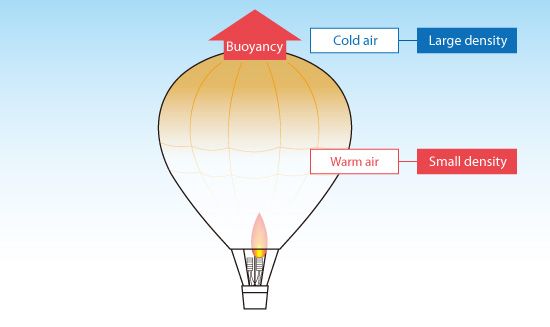
On a more granular level, convection is observable in everyday phenomena, often inspiring curiosity. For instance, consider a hot air balloon—a quintessential representation of convection in action. The balloon rises when air inside it is heated, causing it to expand and decrease in density relative to the cool air outside. This exemplifies the foundational principle of buoyancy arising from convection, and it serves as a captivating demonstration of how heat manipulation can lead to ascension in the atmosphere.
In summary, the movement of air during convection is a complex interplay of temperature differentials, density variations, and external forces such as the Earth’s rotation. This systematic movement is responsible for a myriad of atmospheric phenomena, influencing weather patterns and climatic trends. By understanding these intricate dynamics, individuals can develop a more profound appreciation for the capriciousness of nature and the multifaceted influences shaping our environment.
As we navigate the modern era, recognizing the significance of convection not only sharpens scientific inquiry but also highlights the interconnectedness of our planet’s systems. By fostering curiosity and expanding our perspective on atmospheric processes, we can better engage with the complexities of climate, ultimately guiding us toward more sustainable practices and a healthier planet.

Leave a comment