

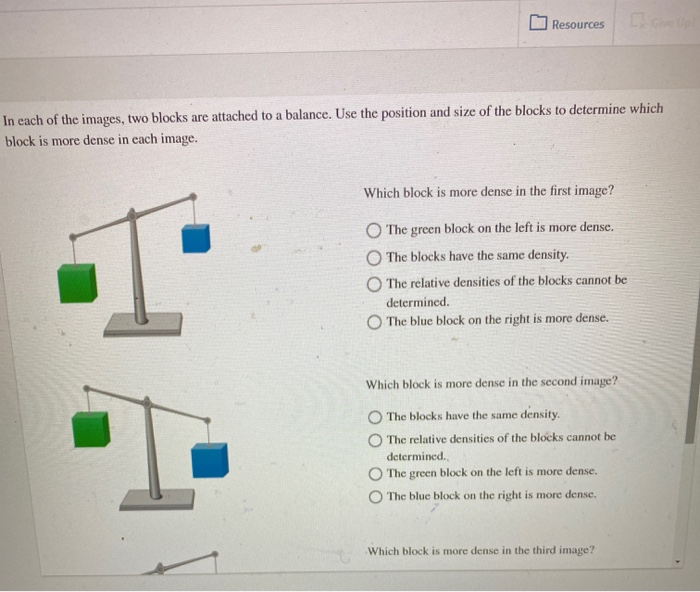
In the realm of physics, the exploration of density emerges as a fundamental and captivating inquiry, often serving as a lens through which we can scrutinize the intrinsic properties of matter. The question at hand, “Which block is more dense in the first image-Physics Visualization,” is a gateway into this complex interplay of mass and volume. To unravel this query, we must delve into the essential definitions and principles that govern density, observe the implications of material composition, and engage with visual representations that enhance our understanding.
Density, defined as mass per unit volume, is expressed in the formula ρ = m/V, where ρ represents density, m denotes mass, and V signifies volume. This fundamental relationship reveals the intimate connection between an object’s weight and the space it occupies. The allure of density lies not merely in its definition, but in its wide-reaching implications across various branches of science and engineering. From buoyancy principles that dictate why some objects float while others sink, to its role in characterizing different states of matter, density serves as a cornerstone concept in understanding the physical world.
As we engage with the visual representation of the two blocks in the first image, it is essential to examine their physical characteristics. Are the blocks of similar size, or do they vary in dimensions? Observing an image often presents a challenge in interpreting volumetric information reliably. A cursory glance might lead one to misapprehend which block appears more substantial or significant, but we must resist the cognitive bias of visual perception alone. Instead, the process of analyzing density mandates careful consideration of both mass and volume.
To determine density accurately, one must first ascertain the mass of each block. This can be achieved through various methods, with some common techniques including the use of scales or weight sensors. Once the mass is obtained, attention shifts to the volume. Volume can be calculated geometrically. For rectangular blocks, this involves the multiplication of length, width, and height. For irregularly shaped objects, water displacement methods may be employed. Understanding the density of each block relies on the successful determination of these two attributes.
Moreover, the materials composing the blocks play a critical role in this inquiry. The types of materials impact not only the inherent density but also the blocks’ structural properties, durability, and potential applications. For instance, a block made of lead compared to one of wood will possess a considerably higher density due to the mass concentration within the same volume. This variation stems from atomic structures—leading materials that are denser typically have tightly packed atoms contributing to their greater mass relative to volume.
The phenomenon of density can also shed light on buoyancy, another captivating aspect of physics. An object’s ability to float or sink within a fluid is predicated on the relationship between its density and that of the fluid. Archimedes’ principle asserts that an object submerged in a fluid experiences an upward buoyant force equal to the weight of the fluid displaced by the object. This principle can lead to fascinating deductions when comparing the densities of two blocks. If one block possesses a density lesser than the fluid, it will float; conversely, if it is greater, it will sink.
In educational settings, visualizations like the image presented serve to enhance comprehension. They offer an empirical way to engage with abstract concepts. Observing physical representations encourages learners to think critically as they assess how density influences other physical properties. Visual stimuli can provoke curiosity and prompt learners to pose questions, guiding them towards deeper investigations into the nature of materials. This interplay between perception and understanding is vital; it emphasizes the importance of not merely observing the blocks but dissecting the underlying principles that dictate their densities.
When engaging with images such as the one referred to, one must also consider the possibility of manipulative experiments or interactive simulations. These tools provide a tactile means of exploring density, allowing individuals to experiment by changing mass or volume and observing resultant impacts on density. Such engagements reinforce theoretical knowledge by bridging the gap between concept and application, leading to profound insights and a lasting fascination with physical sciences.
Additionally, the implications of density extend into practical applications in engineering, where material choice significantly affects sustainability and efficiency in design. Engineers must systematically evaluate the density of materials when constructing various structures. Decisions influenced by density not only promote safety but also consider economic factors, contributing to sustainable practices in modern construction. Thus, the curiosity surrounding which block is denser unveils a larger narrative about how understanding fundamental physics informs real-world applications.
Ultimately, the question of which block is denser serves as a microcosm of broader scientific inquiries. The exploration of density invites individuals to cultivate a sense of wonder about the world. As learners engage with the complexities of density, they not only appreciate the intricacies of physical properties but also develop critical thinking skills essential for navigating scientific challenges. Therefore, understanding which block is more dense is not merely an exercise in measurement—it is an entry point into the vast and enthralling universe of physics and material science.

Leave a comment