

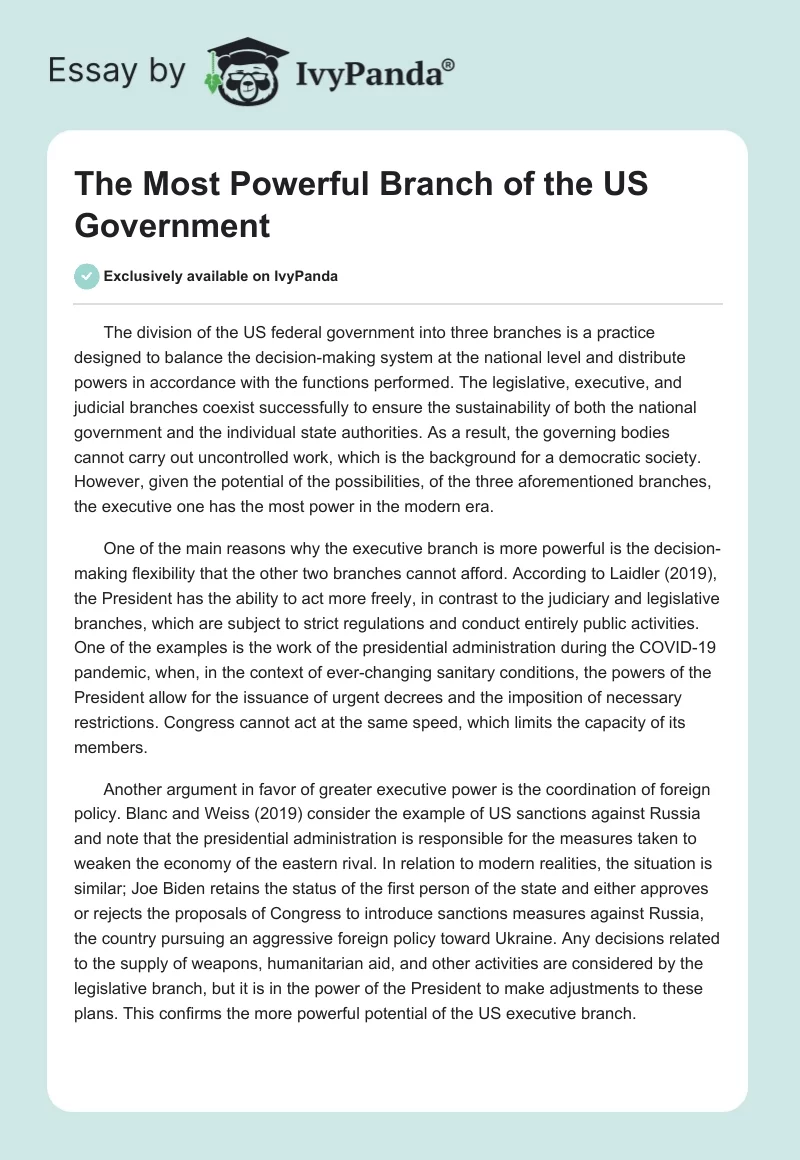
The question of which branch is the most powerful in the United States government often leads to vigorous debate among scholars, policymakers, and citizens alike. The U.S. government is divided into three distinct branches: the legislative, the executive, and the judicial. This tripartite system was deliberately established by the Founding Fathers to ensure a balance of power, mitigate tyranny, and safeguard individual liberties. However, the dynamics of these branches can lead one to ponder: which one truly holds the most influence? In this exploration, we will dissect the characteristics and powers of each branch, examine their interactions, and hopefully provide clarity on this intricate subject.
The Legislative Branch, comprised of the United States Congress, is often viewed as the cornerstone of American democracy. Divided into two chambers—the Senate and the House of Representatives—this branch wields significant authority through its legislative powers. Congress is tasked with enacting laws, levying taxes, regulating commerce, and overseeing the federal budget. Notably, it possesses the unique ability to declare war, thus underscoring its critical role in shaping national policy. Yet, the legislative branch’s power can be curtailed by the very checks and balances it exists within. For instance, a president may choose to veto legislation, effectively halting bills that require bipartisan support. This tension, however, is integral to the democratic process, allowing for extensive discussions and deliberations that adhere to the principles of representation and accountability.
In juxtaposition, the Executive Branch—headed by the President of the United States—embodies the quintessential embodiment of power and authority. The President serves as both the Commander-in-Chief of the armed forces and the face of American diplomacy. With the ability to enforce laws, issue executive orders, negotiate treaties, and wield significant influence over foreign policy, the Executive Branch seemingly possesses a supremely authoritative stature. Moreover, the expanding scope of executive powers, particularly in times of crisis—such as national emergencies or significant military engagements—can render the office of the presidency incredibly impactful. This concentrated power raises concerns regarding executive overreach and the implications it has on democratic principles.
As we delve deeper, the Judicial Branch emerges as the guardian of the Constitution and the arbiter of justice. Comprising the Supreme Court and lower courts, this branch possesses the profound responsibility of interpreting laws and adjudicating their constitutionality. The power of judicial review, articulated in landmark cases such as Marbury v. Madison, enshrines the court’s role in maintaining the rule of law and protecting individual rights. In this capacity, the judiciary can exercise immense influence over societal norms and governmental actions, effectively shaping the law of the land. Yet, despite its pivotal role, the judiciary is often perceived to be reactive rather than proactive, addressing issues as they arise rather than initiating change. This characteristic can lead to debates about its effectiveness in combating social injustices in a timely manner.
Furthermore, the interaction among these branches must be recognized as a crucial factor in determining power dynamics. The intricate system of checks and balances ensures that no single branch becomes preeminent. For instance, while Congress can pass legislation, the President may exercise veto power, leading to potential stalemate. Conversely, the courts may strike down laws perceived as unconstitutional, further complicating the interplay. This interdependence is fundamentally rooted in the Constitution, which designed a framework not merely to allocate power, but to engender cooperation and compromise among the branches.
The discourse surrounding the preeminence of any branch is further complicated by contemporary political contexts. In an age dominated by media and public opinion, the influence of each branch oscillates based on political tides. The President may harness social media to sway public sentiment, while Congress can harness national issues to galvanize support or opposition. In this arena, the power of persuasion becomes paramount, often overshadowing formal authority. The whims of public opinion can effectively elevate the Executive’s standing, while simultaneously undermining legislative authority. Thus, power in government is not static; it is fluid and contingent upon external factors, including public support, media portrayal, and prevailing socio-economic conditions.
In conclusion, positing which branch of government constitutes the most powerful is less a matter of definitive answers and more a reflection of complex interrelations and contextual factors. The Legislative Branch provides a fundamental democratic framework, the Executive Branch wields substantive authority, and the Judicial Branch acts as a crucial check, preserving constitutional integrity. Ultimately, the essence of democratic governance lies not within the supremacy of one branch over another, but rather in their ability to coexist, interact, and balance power in pursuit of the common good. This intertwined relationship fosters a democracy that is resilient, adaptive, and continually evolving to meet the challenges of each new generation.

Leave a comment