

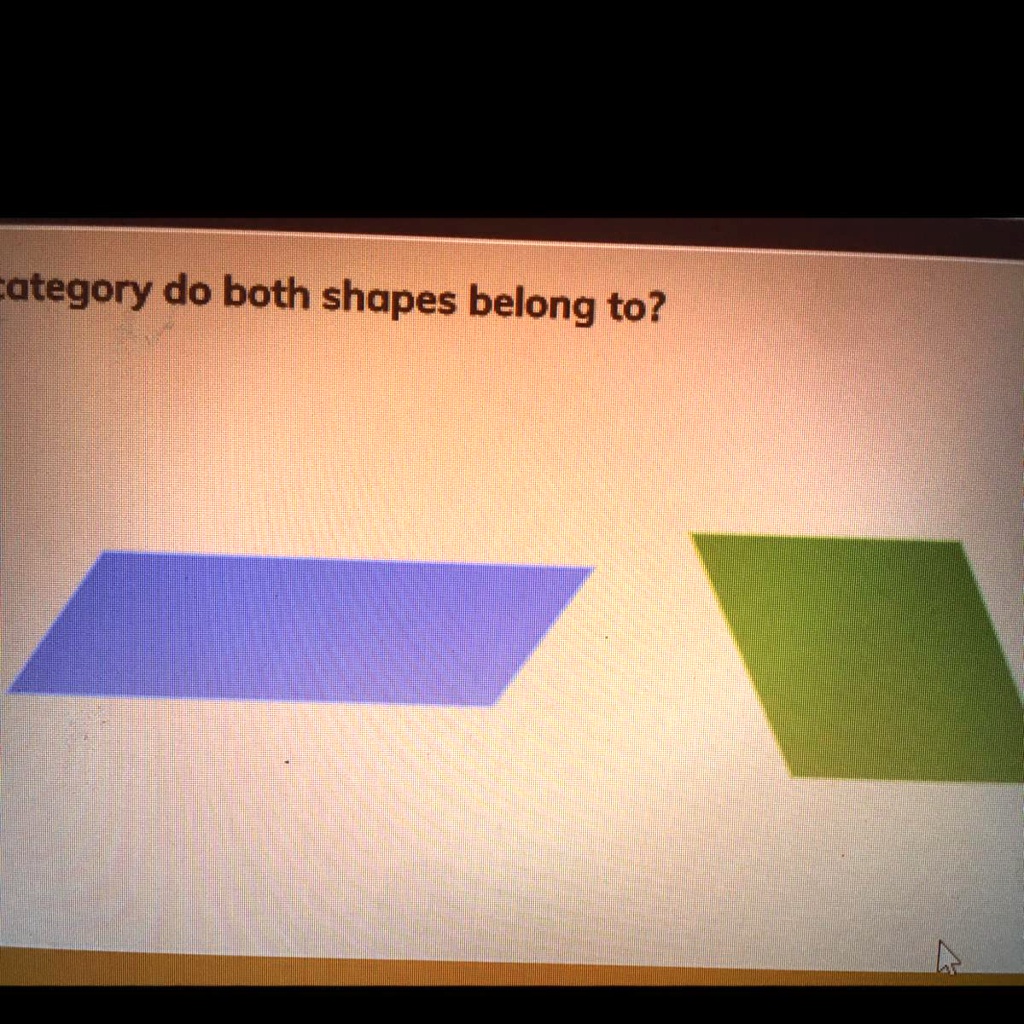
The world of mathematics and logic is replete with rich abstractions and categories that govern the structure of our understanding. Each shape, be it a mere polygon or a complex geometric figure, occupies a space not only within Euclidean realms but also within the cognitive fabric of logic. The inquiry into “Which category do both shapes belong to?” serves as a gateway into this multifaceted domain. Within the realms of geometry and logic, it is beneficial to explore classifications that intertwine with our conceptualizations, thus enabling a more profound appreciation of the inherent order in the chaos of shapes.
At the foundational level, shapes can be bifurcated into categories such as two-dimensional or three-dimensional forms. Two-dimensional shapes, like squares and circles, inhabit a flat plane, encompassing definitions based on their properties. In contrast, three-dimensional shapes, including cubes and spheres, extend into volumetric space, showcasing depth beyond mere width and height. Within these basic delineations lies a deeper narrative, encapsulated in mathematical revolutions and logical postulations that have shaped our understanding of the visual world.
Now, when delving specifically into the realm of two-dimensional shapes, consider the fundamental category of polygons. This broad classification consists of figures characterized by having straight sides, with specific attention to the number of vertices they possess. Among the distinguished members of this class are triangles, quadrilaterals, pentagons, and so forth. Each category embodies foundational principles of mathematics, providing insights into symmetry, tessellation, and even topology.
Focusing on quadrilaterals, we encounter the quintessential square, an unequivocal archetype of geometric purity. A square, as a special type of rectangle, possesses all four sides of equal length and angles measuring precisely 90 degrees. This figure becomes emblematic of stability and uniformity; its symmetry radiates an aura of balance, creating a sanctuary for calculation and rational thought. The juxtaposition with other quadrilaterals – namely, rectangles, rhombuses, and trapezoids – further reveals the philosophical significance of geometric classification, where each member may share characteristics but also diverges in unique ways, contributing to the tapestry of mathematical logic.
Conversely, one might consider circular shapes, such as ellipses and circles themselves, which defy the edicts of segmental straightness. Circles epitomize the notion of curvature, possessing a constant distance from a central point in all directions. This concept introduces fascinating dialogues between shapes; both squares and circles challenge our perceptions, engaging us in an exploration of limits and boundaries. Herein lies an intriguing metaphor: just as a square encloses space in straight lines, a circle envelops it through fluidity, reflecting the duality present within mathematics – the rigidity of structure contrasted with the expansiveness of ideation.
Both categories—polygons and circular forms—bring forth poignant questions regarding dimensionality and spatial reasoning. They can be linked through the lens of transformation, where geometric figures morph under specific parameters. For instance, through dilation, a square may metamorphose into a larger entity while maintaining its geometric integrity. Likewise, a circle can expand under the auspices of scaling while preserving its radii. Such transformations hint at the underlying principles of similarity and congruence, essential pillars of geometric understanding.
Moreover, the encapsulation of these shapes within the broader realms of topology exposes additional layers of classification. Topology is a branch of mathematics that explores properties preserved through continuous transformations. In this dimension, both squares and circles can be perceived as ‘homeomorphic’; that is, each can be deformed into the other without tearing or gluing, positioning them into an elevated category that celebrates not just their immediate visual identities but also the infinite possibilities of their transformation and connectivity.
This leads us into the realm of logic, where shapes serve as paradigms for deductive reasoning. The categorization of shapes invites a symbolic examination, allowing one to juxtapose concrete attributes against abstract reasoning. Consider the implications of using shapes to propose logical arguments: a square might represent rigidity in a logical construct, whereas a circle connotes fluidity—demonstrating how structures can embody different reasoning frameworks. This relationship between shape and logic is not merely a theoretical endeavor; it finds resonance in various disciplines such as computer science and artificial intelligence, where the visual and logical attributes intertwine to create algorithms and programming languages.
As we endeavor to unfold the question of categorization, it becomes evident that both shapes, despite their differences, belong to an overarching realm of mathematical reasoning. The elegance of mathematics lies not solely in its capacity to classify but also in its profound ability to connect disparate concepts under a unified umbrella. This interplay between shapes and their categorization manifests as a symphony of forms, where the aesthetic allure of geometry inspires an insatiable curiosity for exploration and understanding.
In conclusion, the inquiry into the category shared by both square and circle transcends the surface-level properties and delves into a rich tapestry woven with fundamental truths of mathematics and logic. Within the vast landscape of shapes lies an intriguing interplay of classification, transformation, and philosophical contemplation. Both forms, unique yet universally connected, beckon us to embrace the beauty of logical thought and the artistry of mathematical inquiry, inviting us to ponder the uncharted territories that await our exploration.

Leave a comment