

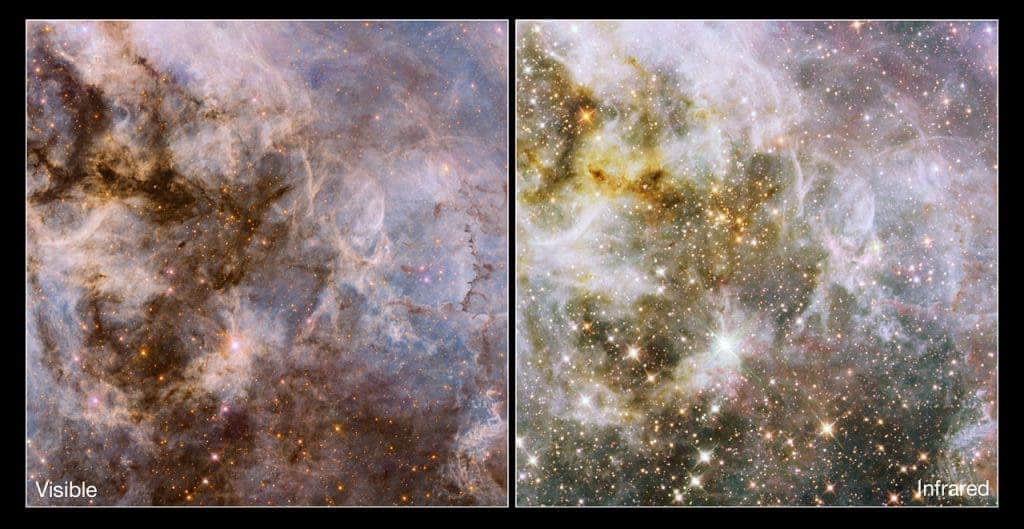
To comprehend the intricate ballet of stellar birth, one must first understand the nebulous realms from which stars emerge—the nebulae. These cosmic clouds, primarily composed of gas (mostly hydrogen) and dust, serve as the crucibles in which nuclear fusion, the process that powers stars, is initiated. However, not all conditions within a nebula are conducive to this monumental reaction. Indeed, several factors can inhibit or entirely prevent nuclear fusion, thwarting the nascent star’s aspirations. This exploration delves into the conditions that inhibit nuclear fusion amidst the glowing tapestry of a nebula.
Among the myriad criteria that influence stellar formation, the **temperature** of the nebula stands as a paramount determinant. For nuclear fusion to commence, the internal temperature must reach approximately 10 million Kelvin—the threshold necessary for hydrogen nuclei (protons) to overcome their electrostatic repulsion. In less heated regions of a nebula, where temperature dips below this cauldron of fervent energy, the requisite kinetic energy of protons remains insufficient to trigger fusion. Consequently, the formation of stars is stifled, leaving the region a mere collection of cold particles floating through the cosmos.
Another critical element impacting nuclear fusion is the **density** of the nebula. Density is defined by the mass of the particles present in a given volume. A nebula rife with sparse regions may exhibit an insufficient gravitational pull, unable to coalesce matter into a compact form requisite for fusion. When the density is low, the particles exist in an exceedingly diffuse state, limiting their interactions. Such interactions are instrumental as they facilitate the requisite conditions for gravitational collapse—an essential precursor to star formation. They stir thermal fluctuations that agitate the particles, driving them toward greater densities proportional to clumping and aggregation. Without these dense regions, the nebula remains a languorous expanse, precluding the violent dance of stellar genesis.
Astonishingly, the composition of a nebula also exerts a pivotal influence on the likelihood of fusion. Specifically, the **metallicity** or the amount of heavier elements (elements beyond hydrogen and helium) profoundly affects stellar evolution. In a nebula dominated by primordial hydrogen and helium, the environment is markedly more favorable for the sonorous fusion of hydrogen into helium. Conversely, if the metallicity is elevated, the presence of elements such as carbon, oxygen, or nitrogen might hinder the fusion process. These heavier elements can absorb energy and disrupt the thermal equilibrium essential for sustaining nuclear reactions. This interplay suggests that a nebula rich in metals might inhibit the orderly progression of stellar formation, creating a tableau teeming with potential yet bereft of stars.
Moreover, **turbulence** within a nebula can further complicate the birth of stars. Cosmic turbulence arises from chaotic motions—fluctuations propagated through the nebula by external forces, such as shock waves or the explosive remnants of nearby supernovae. In turbulent regions, the gas experiences rapid fluctuations in pressure and density, potentially dispersing clumps of matter instead of allowing them to coalesce. Such perturbations can disrupt gravitational collapse, scattering particles instead of facilitating their convergence necessary for forming protostars. The continual upheaval stymies the orderly progression toward nucleation points where fusion might naturally occur, resulting in an environment that is tumultuous yet barren of fledgling stars.
In addition to these physical attributes, **radiation pressure** exerted by surrounding stellar bodies can significantly impede the conditions suitable for nuclear fusion. High-energy radiation emanating from adjacent stars can create wind currents of charged particles that interact destructively with nascent stellar formations. Radiation pressure may counteract the inward pull of gravity, creating a standoff that suppresses the necessary density for fusion initiation. Thus, a delicate balance must be maintained, wherein the forces of creation and destruction engage in a cosmic dance. When too much outward pressure is applied, the very process of star formation falters, leaving stellar nurseries stagnant amidst the cosmos.
Lastly, the role of **external gravitational influences** cannot be overlooked. The gravitational interplay between a nebula and nearby celestial entities can lead to significant alterations in the nebula’s structure and spatial dynamics. For instance, if an external mass—in the form of a black hole or massive star system—exerts a gravitational pull too strong, it may strip stellar material from the nebula. This interaction can deplete the nebula of the mass needed for fusion, causing it to succumb to gravitational turbulence and even fragmentation. Thus, external gravitational forces can lead to the disintegration of an otherwise promising region for star formation, reinforcing the chaotic elements of nebular dynamics.
In conclusion, while the nebula serves as the cradle of stars, several conditions can inhibit nuclear fusion from taking place. The interplay of temperature, density, metallicity, turbulence, radiation pressure, and external gravitational influences conspire to dictate the course of stellar formation. The resultant cosmic dance illustrates a complex balance that leaves even the most promising nebulae devoid of stars, provoking curiosity about the mysteries of the universe. As researchers delve deeper into galactic dynamics and the enigmatic workings of nebulae, they promise to unveil the intricacies of star formation, continually shifting our perspectives on the orchestra of celestial phenomena.

Leave a comment