

In the intricate fabric of societal development, the interplay between progress, morality, and equality stands as a critical trio deserving meticulous consideration. Each of these facets possesses intrinsic importance, yet their relationship is complex, often leading to the ethical conundrums faced by populations worldwide. To aptly navigate this confluence, societies must engage in reflective discourse and pragmatic deliberations. This article delineates the fundamental considerations that societies must address in balancing progress, morality, and equality.
To commence, it is imperative to define the components of this triad. Progress can be construed as the dynamic advance toward improved standards of living, technological innovation, and enhanced societal structures. It manifests in economic growth, educational advancements, and improved healthcare—a trajectory that many evaluate as synonymous with civilization’s ascent. However, progress often comes with a caveat: an ethical imperative to ensure that this advancement does not occur at the expense of moral standards or equitable treatment.
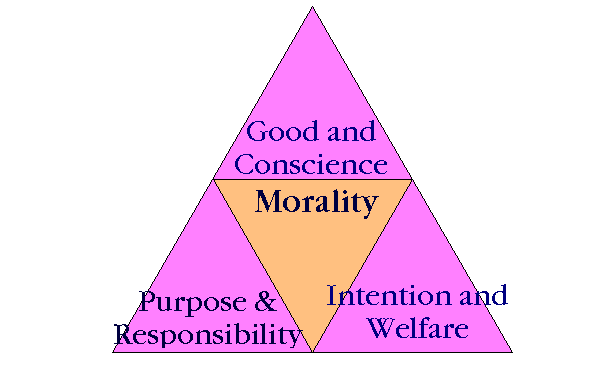
Conversely, morality encapsulates a society’s collective conscience—its values, norms, and ethical principles that guide behavior and decision-making processes. It serves as a compass for distinguishing right from wrong, shaping the very foundations of social contracts. The delicate equilibrium of morality requires societies to critically assess the implications of their choices, particularly in relation to marginalized populations, whose voices might otherwise be muted amid rapid advancement.
Equality, the third vital element, encapsulates the pursuit of equitable treatment and opportunity for all individuals, irrespective of their economic, social, or cultural backgrounds. This principle emphasizes the inherent dignity of each individual and asserts that all members of society deserve fair access to the resources and opportunities that facilitate their development. However, the interplay between progress and equality can often lead to friction, necessitating a nuanced exploration of socio-economic frameworks and policy initiatives designed to mitigate inequalities.
1. The Interdependence of Progress and Equality
In the quest for societal enhancement, the correlation between progress and equality becomes evident. While technological advancements may yield significant economic benefits, such benefits often elude the most vulnerable factions of society. Consequently, disparity can proliferate, thereby generating societal unrest and discontent. The question arises: how does a society ensure that progress is inclusive and beneficial for all?
To address this challenge, it is essential to adopt policies that embrace social entrepreneurship and innovations aimed at reducing inequality. For instance, initiatives that promote equitable education can empower disadvantaged groups by equipping them with the skills and knowledge necessary to participate actively in the burgeoning economy. Inclusive progress should not merely glorify quantitative growth but prioritize qualitative improvements in the human experience.
2. The Role of Morality in Shaping Policies
As society advances, moral considerations must permeate decision-making frameworks. Ethical paradigms serve as the underpinnings for just governance and the establishment of policies that prioritize collective well-being over individual gain. The philosopher John Rawls posited that “justice as fairness” should prevail, wherein the structure of society is such that it ensures the greatest benefit for the least advantaged. Integrating moral philosophy into policy-making processes will invariably result in a more conscientious society—one that values compassion alongside progress.
Furthermore, the ramifications of decisions made under the banner of progress should be scrutinized through a moral lens. For instance, when evaluating the impacts of artificial intelligence on labor markets, it is crucial to consider not only the economic efficiencies gained but also the potential for job displacement. A morally astute society must contemplate the methods of retraining displaced workers and ensuring their reintegration into a secure workforce, thus prioritizing moral responsibility over mere productivity gains.
3. Striking a Balance: Case Studies and Evidence
The efficacy of balancing progress, morality, and equality can be illuminated through case studies from various countries. Scandinavian nations, such as Sweden and Norway, epitomize successful models where social welfare policies prioritize equality while simultaneously fostering an environment conducive to progressive innovation. Their investment in education, healthcare, and social security exemplifies a commitment to moral responsibility without stifling economic growth.
In contrast, societies that have pursued aggressive economic policies without adequate regard for moral implications often face social upheaval. The disparity evident in rapidly developing economies, where the elites benefit disproportionately at the expense of the working class, exemplifies how neglecting equality can lead to societal fractures. Lessons learned from these experiences underscore the imperative that progress should be accompanied by moral foresight and a commitment to equity.
4. The Path Forward: Integrative Approaches
To construct a more equitable and morally sound society, it is essential to advocate for integrative approaches that synchronize progress, morality, and equality. This entails fostering collaborative dialogues across socio-economic and political spectrums, where diverse voices are heard and considered. Engaging in community-based initiatives that prioritize civic participation can galvanize collective action and empower communities to actively shape their destinies.
Moreover, educational institutions play a pivotal role in instilling values of morality and equality. By prioritizing ethical literacy and civic engagement in curricula, future generations will be better equipped to navigate the complexities of societal challenges, fostering a culture that values equilibrium among progress, morality, and equality.
In conclusion, the considerations that a society must address in balancing progress, morality, and equality are multifaceted and interdependent. By embracing a holistic approach that values the intricacies of this triad, societies can aspire toward a more just and harmonious future. The journey toward achieving this delicate balance is fraught with challenges, yet it is a pursuit that holds paramount significance for the well-being of humanity. Embracing this endeavor necessitates wisdom, compassion, and an unwavering commitment to fostering an equitable society for all.

Leave a comment