

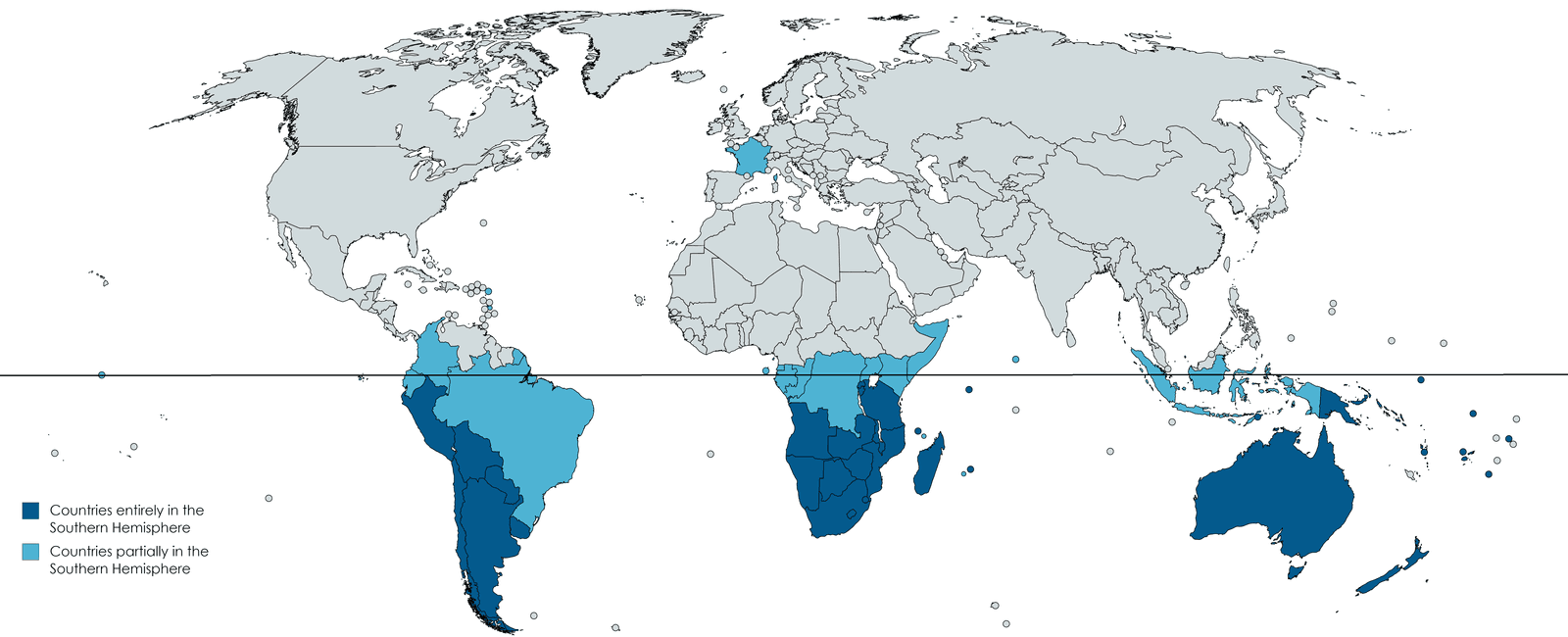
In a world exquisitely divided by lines of latitude, the Southern Hemisphere emerges as a sanctuary, a realm ensconced predominantly by oceans, where two continents remarkably claim their territory. As explorers and scholars navigate the intricacies of our planet, the question arises: which continents reside entirely in this captivating half of the globe? This article delves into the nuances of geography, uncovering the identities of these continents, and highlighting their unique appeal.
To embark on this geographical odyssey, one must first familiarize oneself with the conceptual framework of hemispheres. The Southern Hemisphere, often associated with warmth, lush biodiversity, and vibrant cultures, is a canvas painted with a mosaic of landscapes. Here, one can find vast deserts, verdant rainforests, imposing mountains, and sprawling cities steeped in history.
The first continent that emerges from this southern expanse is **Australia**. An island continent and the smallest of the world’s continents, Australia is a land of contrasts. It is a land reminiscent of a vibrant tapestry, woven with threads of indigenous heritage, modern innovation, and awe-inspiring natural wonders. From the shimmering beaches of the Gold Coast to the rugged Outback, Australia invites exploration and admiration.
Australia is inherently unique, not merely because of its geographic coordinates, but due to its unparalleled biodiversity. The continent is home to a plethora of endemic species, creatures existing nowhere else on earth, like the iconic kangaroo and the elusive platypus. It is a continent that nurtures a delicate balance between nature and civilization. Just as the eucalyptus trees have adapted to survive in the sweltering heat, so too has Australia evolved into a vibrant society that celebrates both its indigenous roots and multicultural melting pot.
As the sun sets over the Outback, casting an orange hue across the vast landscape, one is reminded of the deep connections between the land and its people. The Aboriginal cultures, with their intricate dreamtime stories and art forms, offer a glimpse into a worldview that honors the past while navigating the future. In this sense, Australia serves not only as a geographical entity but as a profound reflection of human resilience and adaptability.
The second continent situated entirely within the Southern Hemisphere is **Antarctica**. Often shrouded in an enigmatic veil of ice and mystery, Antarctica is a formidable giant, distinguished by its inhospitable conditions and breathtaking beauty. Unlike Australia, it is an untouched realm, a pristine environment that serves as the planet’s natural icebox. Stretching over 14 million square kilometers, it is the fifth-largest continent, bellying a complex ecosystem beneath its icy surface.
Antarctica is often viewed through the lens of stark isolation; however, it is precisely this characteristic that imbues it with extraordinary significance. The icy continent plays a pivotal role in regulating the Earth’s climate and is crucial for understanding global environmental changes. The continent is an archive of Earth’s history, preserving ancient ice cores that scientists utilize to study past climates and predict future trends.
The allure of Antarctica lies not only in its scientific value but also in its captivating landscapes. Towering icebergs, surreal glacial formations, and the mesmerizing auroras illuminate the long polar nights. This continent is a sanctuary for a diverse range of wildlife, including penguins, seals, and various seabird species. The Emperor penguin, with its striking black and white plumage, epitomizes the harsh yet beautiful existence within this frigid territory.
Moreover, Antarctica serves as a paragon of international cooperation. The Antarctic Treaty System, a groundbreaking accord signed by multiple nations, emphasizes the collective responsibility towards preserving the continent’s ecological integrity. In some ways, Antarctica stands as a beacon for global solidarity, reminding humanity of the fragility of our planet and the need for unified action.
The significance of these two continents—Australia and Antarctica—extends far beyond their geographical confines. They offer a contrasting tableau that encapsulates the extremes of our planet: one teeming with life and vibrant cultures, the other a vast, icy wilderness supporting delicate ecosystems. Together, they underscore the richness of terrestrial experiences available within the Southern Hemisphere.
Exploring these continents fosters a deeper appreciation for our planet’s diversity. One cannot help but draw parallels between the vibrant life force of Australia and the silent majesty of Antarctica. This dichotomy prompts reflections on the myriad ways in which environments shape human experiences, culture, and history.
In conclusion, understanding which continents are entirely situated in the Southern Hemisphere enhances our grasp of Earth’s geography. Australia and Antarctica, though fundamentally different, offer unique insights into their respective ecosystems and cultures. They serve as reminders that our planet is both a bastion of diversity and a delicate balance of interdependence. Whether one seeks the sun-kissed shores of Australia or the stark beauty of Antarctica, each continent presents an unparalleled opportunity for discovery and enlightenment. Each time we venture into these realms, we rediscover the profound relationships that define our existence on this extraordinary planet.

Leave a comment