

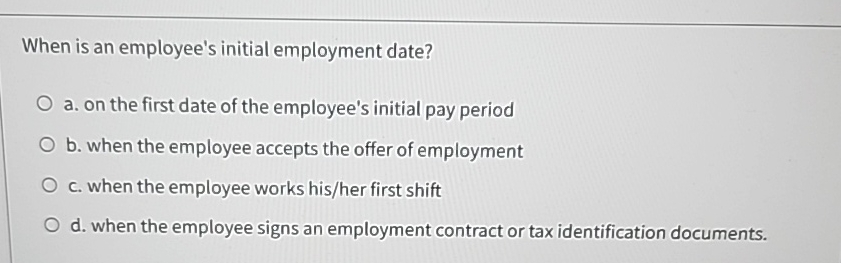
The determination of an employee’s initial employment date is a topic that often elicits much contemplation and debate within human resources and organizational management. This date holds significance not only for the individual employee but also for the organization itself, influencing various administrative processes and benefits. But what exactly constitutes this date? The criteria can be nuanced, varying across jurisdictions, organizational policies, and individual contract conditions. Thus, it is pertinent to dissect this topic thoroughly.
Understanding the Initial Employment Date
At its core, the initial employment date marks the beginning of an employee’s tenure with a company. However, the specificity of this date can change based on numerous factors. Commonly, it is understood as the first day an employee performs duties for the employer, but this definition can be muddied by various circumstances.
Types of Employment Dates
To clarify, it helps to delineate between different employment-related dates:
- Offer Acceptance Date: This is the date when the candidate formally accepts the job offer. While significant, it does not typically serve as the official employment date.
- Start Date: Often regarded as the point when an employee begins fulfilling their work obligations. This date should be clearly articulated in the employment contract.
- Probationary Period Start: Some organizations implement a probationary period where the initial employment date may differ from the official start date. During this time, the employee may be assessed for fit within the organization.
- Service Date: This refers to the date used by the company for the calculation of benefits, seniority, or other employment-related matters. It may coincide with the actual start date or could be adjusted based on organizational policies.
Legal Ramifications
Employers must also navigate a labyrinth of legal prerequisites when designating an employee’s initial employment date. Various labor laws and regulations set forth specific stipulations regarding any form of employment documentation, and failing to accurately acknowledge the initial employment date can lead to legal dilemmas. Moreover, this date can influence entitlements such as benefits, severance pay, and pension eligibility. This underscores the necessity for precise communication and documentation during the onboarding process.
Cultural and Organizational Considerations
Different workplaces foster varying philosophies regarding what counts as the initial employment date. In some cultures, the onboarding process is informally acknowledged, recognizing the value of relationship-building before formal duties commence. In contrast, others may adhere rigorously to contractual definitions, thus strictly aligning the initial employment date with the official start date. This discrepancy often reflects broader organizational values regarding flexibility and navigability.
Contractual Obligations
The language within the employment contract itself is pivotal. Some contracts explicitly state the employment start date, providing clear guidance for both parties. However, ambiguity can arise, particularly when clauses pertaining to start dates and probationary periods are not clearly defined. In these cases, it is critical for both employers and employees to engage in discussions to delineate expectations and responsibilities effectively.
Impact on Employee Benefits
The implications of determining the initial employment date extend to employee benefits. Typically, benefits such as health insurance, retirement contributions, and leave accrual are often computed based on the employment date. For instance, some organizations offer enrollment in benefits plans effective from the initial employment date, while others utilize a later date for activation. Employees should be aware of how their initial employment date influences these essential facets of their employment agreement.
Factors Influencing the Initial Employment Date
In practice, several factors can complicate the determination of an employee’s initial employment date:
- Delayed Start Dates: An accepted offer can sometimes lead to a delayed start due to unforeseen circumstances, yet the accepted offer date should still be captured in records.
- Pre-employment Training: If an organization mandates pre-employment training or orientation, it begs the question of whether this surreptitiously serves as the beginning of employment.
- Independent Contractors vs. Employees: The classification of a worker as either an independent contractor or an employee can alter the perceptions and implications surrounding the employment date.
Conclusions and Best Practices
Establishing the initial employment date is a seemingly straightforward task, yet it is fraught with complexities and underlying implications that merit careful consideration. Organizations are encouraged to develop transparent engagement processes that capture the critical nature of this date and its associated rights and responsibilities. Clear documentation, proactive dialogue, bespoke contracts, and thorough inductions collectively promote clarity. Moreover, fostering an inclusive culture can further help employees navigate their initial employment relationship effectively. By strategically addressing these components, organizations can ensure that both employers and employees embark on a mutually beneficial journey characterized by accountability and transparency.

Leave a comment