

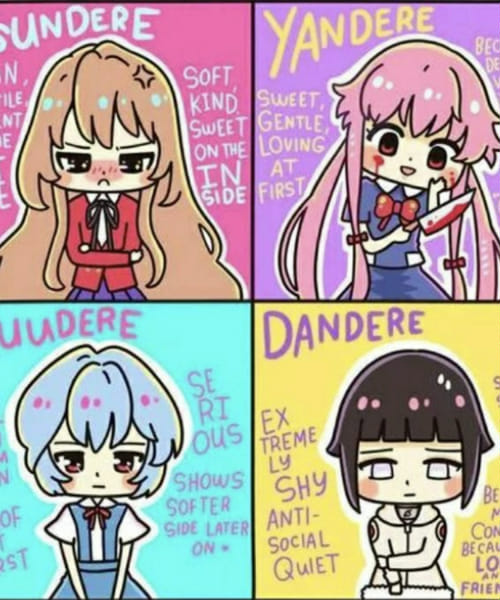
In the ever-evolving landscape of online personality quizzes, the question “Which Dere Are You?” emerges as a captivating invitation to delve into a world characterized by diverse personas and emotional archetypes. This playful inquiry initiates a journey through a tapestry of expressive identities, each offering unique insights into one’s emotional resonance, aesthetic, and social dynamics. To navigate the intricate web of ‘dere’ types, one must first consider the fundamental categories that inform this vibrant dialogue.
At the heart of the ‘dere’ phenomenon lies a quintessence of contrasting yet complementary personas. For instance, consider the archetype of ‘Kawaii Dere,’ where the essence is wrapped in sweetness and innocence. This persona embodies a soft, approachable aesthetic, reminiscent of a bubblegum landscape dotted with pastel hues. Here, individuals channel the joy of simple pleasures, often characterized by an exuberant childlike disposition. They flourish in environments that foster creativity and whimsy, making them the nurturing spirits that elevate the collective mood.
In stark contrast, we encounter the ‘Tsundere’ archetype, a complex amalgamation of affection and hostility. The Tsundere’s behavior oscillates like a pendulum, swinging between moments of fierce, often comedic resistance and soft, vulnerable affection that is slowly revealed over time. This duality resonates deeply with the human condition; it encapsulates the struggle between vulnerability and self-preservation. The Tsundere captures the essence of unresolved emotions, serving as a metaphor for the intricacies of modern relationships where barriers often obscure genuine sentiment.
As we traverse further along this spectrum, the ‘Yandere’ persona emerges—equally captivating yet dangerously obsessive. The Yandere’s fervent fixation can pulsate with intensity akin to a double-edged sword; it holds the potential for tragic romance. This character paints a vivid picture of love intertwined with obsession. In literature and media, the Yandere acts as a cautionary tale, illustrating the sometimes fine line between devotion and destruction. Through this persona, one contemplates the essence of love itself: its capacity to elevate or dismantle.
Conversely, the ‘Dandere’ offers a refreshing reprieve with its unassuming charm. Characterized by introversion and a tendency to retreat into silence, the Dandere embodies the beauty of quietude. This persona celebrates subtlety and introspection, often flourishing in the background, observing the vibrant colors of life while struggling to step into the limelight. Within the pervasive noise of modern existence, Dandere individuals often possess a profound depth, inviting others to consider the complexities hiding beneath the surface of shyness.
The rich fabric of ‘dere’ identities does not end here. The ‘Undere’ brings forth a thrilling juxtaposition, introducing a willingness to acquiesce while harboring deeper emotional layers. This persona is characterized by an overwhelming desire to please while simultaneously battling internal conflicts. The Undere’s earnest nature is often steeped with vulnerability, and their charm lies in their ability to resonate strongly with those who have faced similar dichotomies; a subtle reminder that self-assertion can be beautifully intertwined with self-sacrifice.
Beyond these pivotal personas, one must also consider the multitude of subcategories and hybrid combinations that enrich the landscape of ‘dere’ identities. In an increasingly interconnected society, individuals often find resonance in more than one archetype. The unique blend of traits creates multifaceted personas that better encapsulate the profound complexity inherent in human emotions. Thus, the exploration of ‘dere’ types becomes not merely an exercise in identification but a voyage through depth and nuance.
The allure of engaging with ‘dere’ types extends beyond mere curiosity; it serves as a reflective lens through which individuals can confront their own identities. These personas allow for a nuanced understanding of emotional expression, revealing how cultural narratives shape one’s self-image. Such explorations often create pathways for dialogue, offering individuals the opportunity to celebrate their uniqueness while bridging connections with others who may share similar traits.
Embracing the multiplicity of ‘dere’ identities can be exhilarating. It affords individuals the freedom to explore their traits and to cultivate authenticity in a world that often demands conformity. Engaging with these personas can foster a sense of community, creating spaces where differences are not only embraced but celebrated. In this celebration of diversity, individuals encounter empathy and understanding that transcend superficial interactions.
Ultimately, the question “Which Dere Are You?” serves as an imaginative portal into self-discovery, catalyzing introspection and dialogue. Each ‘dere’ type encapsulates an extraordinary narrative—a thread woven through the vast tapestry of human experience. By embracing these identities, individuals embark on a journey of understanding themselves and others, discovering not only who they are but also the intricate connections that bind them to the rich mosaic of humanity.
As we create further connections with these personas, we unlock the potential for greater empathy and understanding, fostering a culture where the celebration of each ‘dere’ contributes to a collective narrative that honors the diversity of the human spirit.

Leave a comment