

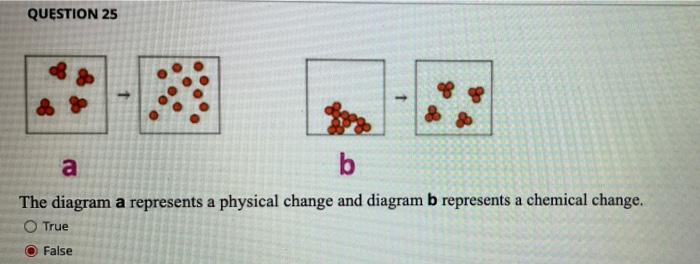
The concept of change resonates deeply within the realms of science, encapsulating both the transformational and the static. Physical changes, akin to a kaleidoscope’s shifting patterns, capture the essence of matter’s ability to alter its form while retaining its intrinsic properties. To discern which diagram solely encapsulates a physical change, one must first embark on an exploration of the characteristics that delineate this distinction from chemical changes.
At its core, a physical change involves an alteration in the appearance or state of a substance without a concomitant transformation in its chemical composition. Like a fleeting wisp of smoke that changes shape yet remains smoke, the essence of the substance remains intact. This principle is pivotal when evaluating diagrams that illustrate various processes or phenomena. Such visual representations often embody complex interactions, and differentiating between physical and chemical changes is crucial for sound scientific interpretation.
Consider the primary characteristics defining physical changes: these include modifications in size, shape, phase transitions (solid to liquid, liquid to gas, etc.), and dissolving processes. Each of these features serves as a beacon in our inquiry. To determine which diagram illustrates a physical change, we will dissect these characteristics methodically.
Firstly, observe representations of phase changes. One might encounter an image depicting water transitioning from ice to liquid form. This transition manifests as an overt physical change, observable in the molecular arrangement without altering the water’s fundamental chemical structure (H₂O). The ice melts, and while its density and appearances differ, the monolithic identity of water remains steadfast.
Secondly, consider shapes and sizes, elements that can transform without any chemical alteration. An illustration showcasing the cutting of a fruit, for instance, demonstrates a physical change. The fruit’s identity persists—regardless of whether it is whole or diced, the biochemical entities defining its nature remain unscathed. This principle echoes throughout various images: crushing a can, shaping clay, or stretching a rubber band are quintessential examples that resonate with the fluidity of physical change.
In contrast, one may encounter illustrations of chemical changes that often betray the simplicity of physical transformations. These might depict rust forming on iron or a plant undergoing photosynthesis. In these scenarios, new substances emerge, and while visually compelling, they constitute chemical transformations that irrevocably alter the original materials. This stark contrast lays the foundation for recognizing true representations of physical versus chemical shifts.
Moreover, let us delve into the concept of dissolving, a phenomenon that brilliantly encapsulates physical changes. Imagine the dissolution of sugar in water. Here, one observes a seemingly effervescent process where sugar molecules disperse within the solvent, creating a solution. What remains constant is the chemical identity of both the sugar and the water. Thus, images illustrating this dissolution process signify physical changes, where the molar identity of substances is upheld even as their physical state alters temporarily.
Engaging further with our inquiry into diagrams, we uncover the significance of detailed depictions. A simplistic drawing showcasing a changing state, such as melting or freezing, provides a clear narrative of physical alteration. Conversely, illustrations laden with complex reactions, such as those depicting burning, oxidation, or reaction with acids, tend to mask their chemical underpinnings and convey a misleading portrayal. Thus, when contending with diagrams, the specificity and clarity of representation become paramount in discerning physical changes.
Furthermore, one must be attuned to nuances. An image illustrating fireworks is illustrative of chemical changes, where exothermic reactions craft brilliant displays while formidable gases escape, altering constituents definitively. Yet, juxtaposed against such examples are depictions of ice forming, an endearing reminder of nature’s transient states—here, water molecules merely rearranged in a solid lattice, a dance of physical change, leaving the chemical identity of water entirely untouched.
Understanding these distinctions leads us to the realm of educational inquiry. Students, often grappling with concepts of matter changes, must navigate these waters with critical thought. Educators, on their part, can foster deeper comprehension by highlighting clear visual examples and promoting active discussions around defining characteristics. Thought-provoking questions posed to students can encourage engagement; queries such as “What happens to the substance at a microscopic level during these changes?” or “Can you classify this diagram as physical or chemical based on its depiction?” are essential in nurturing analytical skills.
Ultimately, the allure of diagrams representing physical changes lies not merely in their visual appeal, but in the fundamental truths they convey. They serve as invaluable tools, illuminating the principles of matter in flux. By carefully scrutinizing and delineating the characteristics that guide us towards identifying these changes, one is endowed with a deeper appreciation for the intricate dance of the tangible world. It is through this understanding that we garner respect for the phenomena that govern our universe, revealing the immutable identity of substances even amid their variable forms.
In summation, selecting a diagram that solely exemplifies a physical change invites one to embrace a myriad of possibilities anchored in the steadfastness of chemical identity. Whether through melting, dissolving, or altering shape, the essence remains untainted. This critical understanding empowers not only the scientific mind but also cultivates a profound respect for the simplicity and complexity entwined within the physical laws of our existence.

Leave a comment