

The allure of diamonds is transcendent—a metaphorical sun that eclipses all other gemstones in its ability to capture our fascinations and aspirations. Yet, in a world where authenticity often dances amid the shadows of imitation, diamond simulants have emerged as captivating counterparts, each possessing its own unique characteristics. Among these simulants, some offer visual phenomena that not only resemble their natural counterparts but also captivate the beholder with their exceptional optical properties. The focus of this discourse is on which diamond simulant exhibits noticeable doubling and strong dispersion, an enthralling aspect that often remains underappreciated in the realm of gemology.
To unravel this delicate tapestry of light and reflection, we delve into the quintessential attributes of notable diamond simulants, evaluating their performance through the prism of two extraordinary optical features: doubling and dispersion. Doubling is a phenomenon that makes facets appear to be mirrored, creating a chiaroscuro effect that breathes life into a gemstone. Dispersion, on the other hand, is often characterized by the separation of light into its constituent spectral colors—an attribute reminiscent of a prism casting rainbows on a sunlit canvas.
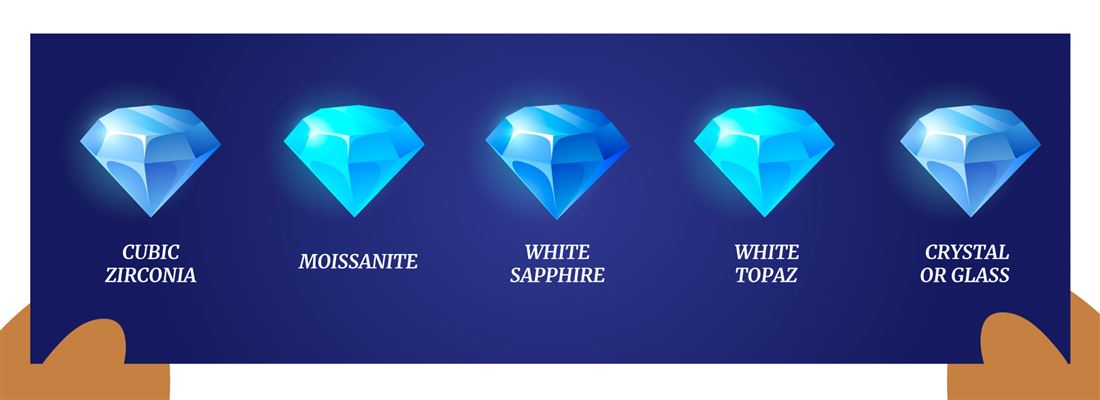
First, we turn our attention to the renowned moissanite, arguably the most celebrated diamond simulant on the market. This silicon carbide gem possesses remarkable crystalline structures that grant it an extraordinary level of brilliance. Its birefringence—a characteristic that allows light to be divided into two different indices—bestows upon moissanite a notable doubling effect. Observers may witness this asset through a gemological microscope, where facets appear to shimmer in a ghostly dance, adding depth and dimension akin to a masterful painting. Furthermore, moissanite boasts a higher dispersion than diamonds, creating a cacophony of color often referred to as ‘fire.’ This optical spectacle is akin to swirling colors in an artist’s palette, making moissanite an enticing alternative for those seeking elegance coupled with exuberance.
However, moissanite is not the sole contender. Enter cubic zirconia (CZ), a simulant crafted from zirconium dioxide, which has gained popularity due to its striking resemblance to diamonds. CZ can exhibit an impressive level of brilliance and is often created to mimic the appearance of high-quality diamonds. Yet, it is the double refraction that sets CZ apart; while the doubling effect can be seen through a jeweler’s loupe, it may be considered less pronounced than that of moissanite. CZ’s dispersion is also commendable, although it tends towards a glassy finish rather than the vivid fire associated with moissanite. In essence, while cubic zirconia may lack some of the flamboyance of its counterparts, it provides a dependable and economical choice for the gem enthusiast seeking beauty without the hefty price tag.
Beyond moissanite and cubic zirconia lies the enigmatic realm of lab-created diamonds. These gemstones are chemically equivalent to natural diamonds, often lacking the optical anomalies that characterize many synthetic simulants. However, lab-created diamonds can display double refraction under specific conditions, albeit this attribute is typically less discernible compared to that seen in moissanite. The allure of lab-created diamonds lies not in their potential for doubling or dispersion but their ethical lineage and identical nature to mined diamonds, making them a compelling choice for conscientious consumers.
As we venture further into the kaleidoscope of diamond simulants, we must not overlook the lesser-known contenders such as white sapphire and synthetic blue sapphire, which can exhibit elements of dispersion. White sapphires are prized for their hardness and durability; however, their double-refraction properties may not yield the same captivating effects as their more illustrious counterparts. The unique confluence of durability and understated elegance in sapphires offers a sophisticated option for those who value subtlety over spectacle.
In the grand tableau of diamond simulants, one must also appreciate the aesthetic preference of the individual. The allure of noticeable doubling and strong dispersion may traditionally reside in the realm of moissanite, yet what resonates with one gem enthusiast may starkly contrast another’s desires. The shimmering intrigue of moissanite may evoke exuberance, while the serenity of a white sapphire may speak to the soul of minimalism. Hence, the quest for the perfect diamond simulant involves an intimate intersection of optical properties and personal ethos.
Ultimately, the search for which diamond simulant shows noticeable doubling and strong dispersion cannot be confined to one decisive conclusion, but rather expands to embrace a realm of choices. Moissanite serves as the veritable beacon of brilliance, inviting the observer into a world of vibrant light and color. Cubic zirconia offers a reliable alternative, while lab-created diamonds parade their legitimacy as natural jewels. Each simulant is distinct, cloaking its wearers with a gleam that can illuminate even the darkest of nights. The decision rests within the realm of personal taste and desire, for in the universe of gemstones, beauty ultimately resides in the eye of the beholder.

Leave a comment