

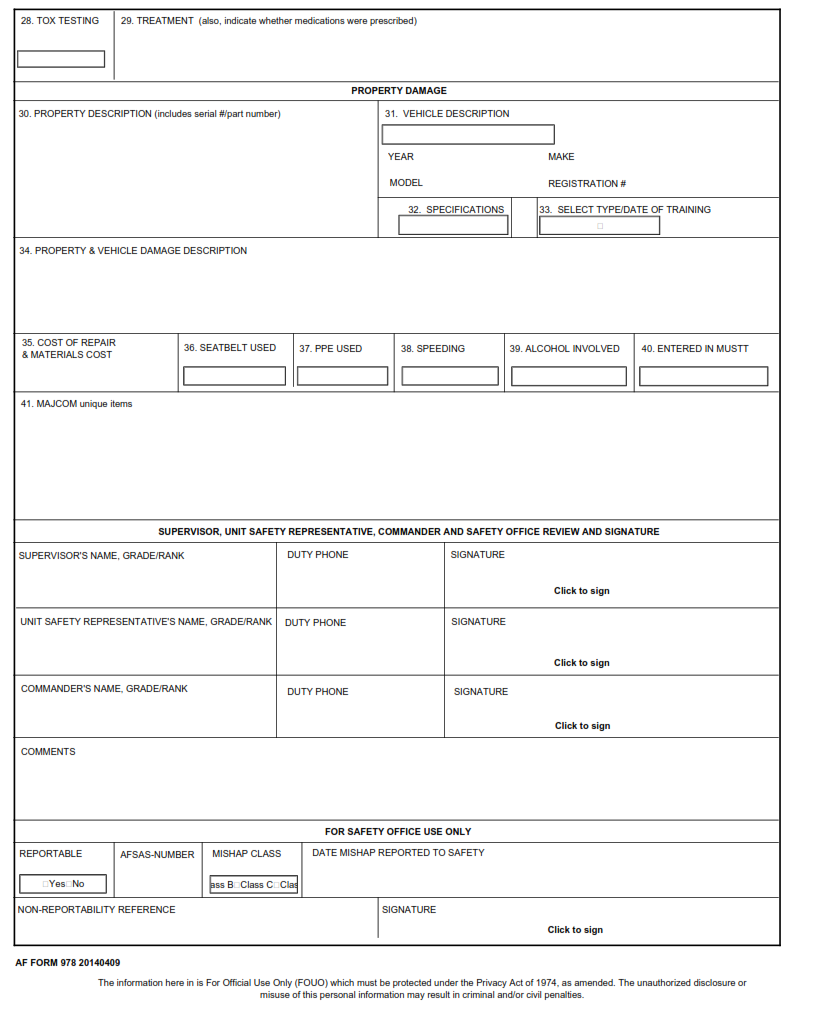
When a mishap occurs in a workplace or organizational environment, the clarity and accuracy of the reporting function as the bedrock of safety and improvement. While there are various forms available for documenting incidents, the specific form that a supervisor should utilize is critical in ensuring proper communication of the circumstances surrounding the incident. In this article, we delve into the intricacies of mishap reporting, illuminating the AF 978 form, which serves as a pivotal tool for supervisors in such situations.
First, it is vital to contextualize what constitutes a mishap. A mishap, in a broad sense, can be defined as any unplanned or unexpected event that results in or has the potential to cause injury, illness, or damage to people, property, or the environment. This definition underscores the importance of swift and comprehensive reporting to preempt further consequences and facilitate remedial action.
Now, let us explore the AF 978 form—officially known as the Supervisor Mishap Report. This form has been meticulously designed to capture essential details regarding the incident efficiently. Supervisors are duty-bound to complete this document following a mishap in their jurisdiction. The utility of the AF 978 form lies not only in its expediency but also in its structured format, which simplifies the gathering of data that will ultimately inform safety protocols and risk management strategies.
Upon initiating the reporting process, a supervisor should first familiarize themselves with the form’s distinct sections. The form is compartmentalized to elucidate various facets of the mishap. Primarily, it requires foundational information, such as the date, time, and location of the incident. This data is vital for constructing a timeline that aids in analyzing patterns and identifying hotspots within the workplace where incidents may recur.
Next, the AF 978 calls for a detailed description of the circumstances surrounding the mishap. Herein lies an opportunity for supervisors to exercise their observational acumen. It is essential to provide a nuanced account of the events leading up to the mishap, emphasizing both the sequence and nature of actions taken by personnel. This section is pivotal, for it offers insights into operational failures or behavioral discrepancies that may have precipitated the event.
Moreover, the form prompts the supervisor to note the individuals involved, including witnesses. This aligns with the principle of accountability and ensures that every contributing factor is acknowledged. By doing so, the organization can track trends in mishaps and examine the relationship between personnel actions and safety outcomes. The AF 978 thus acts not only as a record but as a catalyst for change.
The reporting process also includes sections for noting contributing factors and potential preventive measures. This aspect of the form encourages a paradigm shift in how mishaps are perceived. Rather than viewing incidents merely as unfortunate events, the AF 978 facilitates an understanding of the systemic issues that may contribute to these occurrences. By analyzing the causal factors, supervisors can engage in constructive dialogues regarding improvements in training, resource allocation, and operational procedures.
Furthermore, the AF 978 form is designed to be user-friendly, yet its completion can still pose challenges, especially in high-stress environments. To alleviate these difficulties, training sessions can be instituted, ensuring that supervisors are well-versed in the form’s requirements and the implications of accurate reporting. This not only fosters a culture of safety but also enhances the professional development of the supervisory staff.
It is also imperative to highlight the role of follow-up in the mishap reporting process. After the AF 978 has been submitted, proactive measures must be taken to analyze the information and implement recommended changes. This cyclical approach to reporting not only closes the loop but also establishes a framework for continuous improvement within an organization’s safety culture. Supervisors should champion these follow-up discussions, inviting input from staff to generate innovative solutions to minimize future mishaps.
In conclusion, the AF 978 form stands as a fundamental instrument in the arsenal of supervisors tasked with ensuring workplace safety. Its structured format empowers supervisors to document mishaps with precision and encourages a holistic view of safety management. By utilizing this form effectively, organizations can shift perspective from reactive measures to proactive enhancements. Ultimately, a commitment to thorough mishap reporting fosters an environment where safety becomes ingrained in the organizational ethos, engendering trust and accountability among all employees.
Adopting a conscientious approach toward the completion and processing of the AF 978 form not only aids in legal compliance but, more importantly, it reflects a commitment to the welfare of personnel and operational integrity. As we strive for excellence in workplace safety, the significance of this often-overlooked document cannot be understated.

Leave a comment