

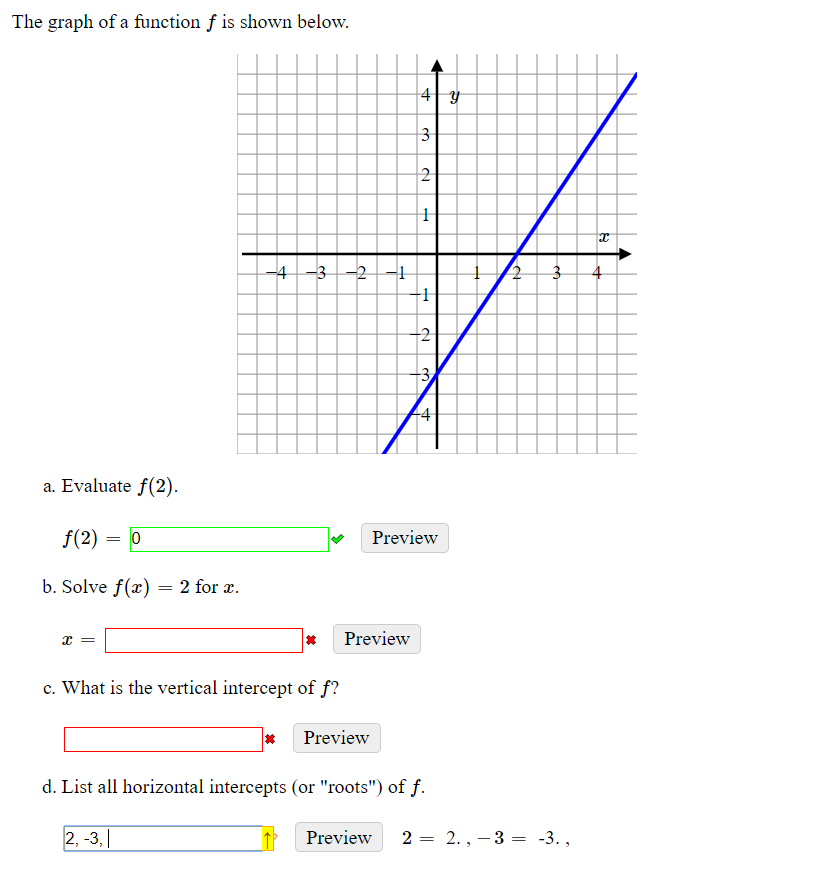
In the vast realm of mathematics, functions serve as the backbone of numerous theories and applications. The beauty of functions lies not only in their mathematical significance but also in their inherent ability to represent real-world scenarios. The question “Which function describes the graph shown below?” invites both contemplation and analysis. To embark on this exploration, we must delve into the foundational aspects of functions, their characteristics, and offer a systematic approach to identify the function corresponding to a given graph.
Function identification requires a profound understanding of various foundational properties. Firstly, functions are defined as relations that assign each element of a domain to exactly one element in a codomain. The essence of a function can be succinctly summarized by the notation f(x), where the variable x represents the input from the domain.
To unravel the mystery of the specific function depicted in the graph, one must analyze its distinctive attributes. Graphs exhibit several key characteristics: intercepts, asymptotes, periodicity, and end behavior. Each of these properties unveils a layer of insight that aids in discerning the underlying function.
Begin with the intercepts, which are points where the graph intersects the axes. The x-intercept occurs when y equals zero, while the y-intercept is found when x equals zero. Identifying these points can considerably narrow down the array of possible functions. For instance, if the graph crosses the y-axis at (0, 2) and the x-axis at (3, 0), one could postulate a linear function such as f(x) = mx + b where m and b are derived from these intercepts.
Next, consider the asymptotic behavior of the graph. Asymptotes are lines that the graph approaches but never touches. They can be vertical, horizontal, or oblique. Vertical asymptotes typically indicate points of discontinuity in rational functions, while horizontal asymptotes reveal the end behavior of the function as x approaches infinity. For example, a rational function like f(x) = 1/(x – a) will exhibit a vertical asymptote at x = a and may stabilize to a particular value as x moves towards infinity.
Periodicity is another remarkable feature worth examining. Functions such as sine and cosine exhibit periodic behavior, characterized by repeating intervals. If the graph demonstrates uniform repetition, one may consider trigonometric functions as potential candidates. Recognizing the periodic length can be instrumental in establishing possible equations, as periodic functions typically conform to the form f(x) = A * sin(Bx + C) + D, where A, B, C, and D are constants that alter the amplitude, frequency, phase shift, and vertical shift respectively.
End behavior analysis entails observing how the graph behaves as x approaches positive or negative infinity. Does the graph rise or fall without bound? Is there a tendency to stabilize? Polynomial functions, for instance, exhibit specific end behaviors based on their degree and leading coefficients. A polynomial of even degree with a positive leading coefficient will rise to positive infinity on both ends. In contrast, an odd-degree polynomial will diverge in opposite directions, creating a distinct graph shape.
A significant technique for identifying the function type involves employing the first and second derivatives. The first derivative informs us of the function’s rate of change, effectively revealing critical points and intervals of increase and decrease. The second derivative, conversely, provides insight into the concavity of the graph, determining whether it curves upwards or downwards. A transition between concavity indicates the presence of an inflection point, further shaping our understanding of the graph’s nature.
When tasked with determining which function resonates with the given graph, it is imperative to synthesize all these attributes comprehensively. Begin by observing the overall shape of the graph. Is it linear, quadratic, exponential, or logarithmic? Each category has its distinct behavioral signatures. For instance, linear functions appear as straight lines, quadratic functions exhibit parabolic shapes, and exponential functions demonstrate rapid increases.
Once a preliminary identification occurs, one may then formulate potential equations. By selecting crucial points derived from the graph – specifically intercepts and turning points – one can utilize point-slope form or vertex form to create a mathematical representation of the function. Employing technology, such as graphing calculators or software, can also facilitate this process, allowing for dynamic manipulation and observation of the function’s behavior.
Moreover, an experimental approach is invaluable. By inputting assumed equations into computational tools and comparing the output graph to the provided graph, one can discern whether a function is indeed correctly identified. Iteration is key; adjusting parameters can lead to a more accurate representation.
In conclusion, answering the pivotal question of “Which function describes the graph shown below?” necessitates a thorough examination of the graph’s properties, followed by a systematic approach of elimination and hypothesis testing. By delving into the nuances of intercepts, asymptotes, periodicity, end behavior, and derivative analysis, one can unveil the compelling story encapsulated within the graph. This multifaceted exploration not only enhances mathematical comprehension but also encourages a heightened curiosity for the intricate relationships between visual representations and their underlying algebraic identities.

Leave a comment