

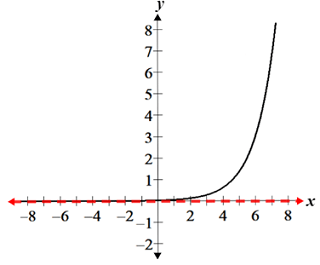
To delve into the intriguing realm of functions and their horizontal asymptotes, one must first grasp the fundamental concept underlying these mathematical properties. Horizontal asymptotes delineate the behavior of a function as the independent variable approaches positive or negative infinity. Specifically, we shall explore functions that asymptotically approach the constant value of three as ( x ) diverges towards infinity. This inquiry not only exemplifies the characteristics of various functions but also illuminates the captivating relationship between calculus and real-world phenomena.
Horizontal asymptotes, a concept primarily originating from the study of limits in calculus, offer profound insights into how functions behave at their extremities. In essence, when a function ( f(x) ) tends toward a specific value ( L ) as ( x ) approaches either positive or negative infinity, the equation ( y = L ) is recognized as a horizontal asymptote. Hence, our primary focus is to identify functions where such a condition results in ( y = 3 ). This exploration necessitates an examination of various categories of functions including rational, exponential, and logarithmic types.
Rational Functions: A Gateway to Asymptotic Analysis
Rational functions, defined as the ratio of two polynomial expressions, frequently exhibit horizontal asymptotic behavior. For any rational function given by ( f(x) = frac{P(x)}{Q(x)} ), where ( P(x) ) and ( Q(x) ) represent polynomials, the asymptotic behavior as ( x ) approaches infinity can be deduced from the degrees of these polynomials. If the degree of the numerator is less than the degree of the denominator, the function approaches zero. Conversely, if the degrees are equal, the function approaches the ratio of their leading coefficients.
To achieve a horizontal asymptote of ( y = 3 ), consider the rational function ( f(x) = frac{3x^2 + 1}{x^2 + 2} ). Notably, both the numerator and denominator possess the same degree (degree 2). Consequently, as ( x ) approaches infinity, the function converges to ( frac{3}{1} = 3 ), effectively confirming the presence of a horizontal asymptote at ( y = 3 ).
Exponential Functions: The Realm of Growth and Decay
Turning our gaze to exponential functions, we find a diverse array of behaviors, particularly in the context of asymptotic analysis. Consider a function of the form ( f(x) = 3 + e^{-x} ). As ( x ) progresses towards infinity, the component ( e^{-x} ) decays towards zero, resulting in a limit where ( f(x) ) approaches 3. Thus, the function displays a horizontal asymptote at ( y = 3 ). In this case, the utility of exponential decay in a mathematical model enhances comprehension of growth patterns in various natural contexts, such as population decline or radioactive decay.
Logarithmic Functions: An Intriguing Perspective
Logarithmic functions, often less intuitive, provide yet another fascinating avenue for discovering horizontal asymptotes. An example can be illustrated with the function ( f(x) = 3 + log(x) ). Regarding this function, as ( x ) approaches infinity, ( log(x) ) continues to grow albeit at a diminishing rate. Nevertheless, it can be demonstrated that logarithmic functions do not possess horizontal asymptotes in accordance with traditional definitions since they exhibit unbounded growth. This underscores the complexity of representing horizontal asymptotic behavior in functions of diverse nature.
Piecewise Functions: A Construct of Mathematical Creativity
The versatility of mathematical functions also allows for the exploration of piecewise definitions. For instance, consider the function defined as follows:
f(x) = {
  3, if x ≤ 0
  0.5x + 3, if x > 0
}
In this case, as ( x ) approaches negative infinity, the function remains consistently at 3. However, as ( x ) approaches positive infinity, the linear component introduces a divergence from the horizontal asymptote at ( y = 3 ). Thus, while this piecewise function exhibits a horizontal asymptote in one domain, it transitions into a different behavior in another, illustrating the rich tapestry of function characteristics.
Applications and Implications of Horizontal Asymptotes
Understanding horizontal asymptotes is pivotal for numerous applications across diverse fields including physics, engineering, and economics. In models depicting population dynamics, for instance, an equilibrium population level can be represented by these asymptotic values. Furthermore, economists may rely on asymptotic behavior in predicting market trends as they model vendor prices tending to a stable value over time.
The analysis of horizontal asymptotes not only enriches one’s understanding of mathematics but also cultivates an appreciation for the models that mirror real-world complexities. As such, by engaging with functions that present an asymptote of ( y = 3 ), one embarks on a transformative journey through the endless possibilities of mathematical exploration.
Embracing this knowledge allows one to approach problems with a nuanced perspective, fostering a deeper connection with the subject matter that transcends mere computation. As you navigate through the mathematical landscape, consider the elegance of simplicity amid complexities—the horizontal asymptote serving as a beacon guiding the way toward mathematical clarity.

Leave a comment