

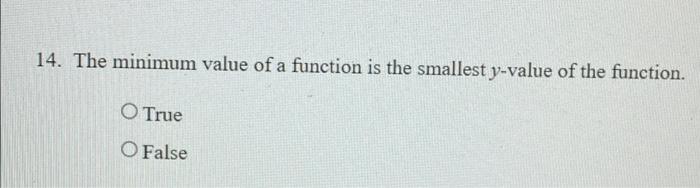
Mathematics often elicits a profound curiosity, especially when it delves into the intricacies of functions and their behaviors. Among the various properties of functions, the concept of a function’s minimum value captures a significant interest. It beckons the inquiry: which function possesses the smallest minimum y-value? This exploration is not merely academic; it is a window into the elegance and complexities underlying mathematical modeling in various fields.
To embark on this journey, one must first contemplate the nature of functions. A function can be succinctly defined as a relation that assigns each input exactly one output. The quest for the function with the least minimum y-value leads us to consider the commonly studied types of functions, primarily polynomial, exponential, logarithmic, and trigonometric functions. Each type has unique properties and behaviors, and their minimum values can offer insights into their graphical representations.
First, the quintessential class of functions is the polynomial functions. These are expressed in the form of ( f(x) = ax^n + bx^{n-1} + … + z ), where ( n ) is a non-negative integer and ( a, b, z ) are constants. A well-known example is the quadratic function, represented as ( f(x) = ax^2 + bx + c ). Polynomials have the characteristic that their local minima can often be found through calculus, specifically by taking the derivative and setting it to zero. Depending on the coefficients, the minimum value can be derived from the vertex of the parabola. Hence, for quadratics where ( a > 0 ), the minimum value occurs at the vertex ( x = -frac{b}{2a} ) and plugging this back into the function reveals the minimal output.
Among polynomials, higher-degree functions can have more complex behaviors. For instance, cubic or quartic functions may exhibit multiple local minima and maxima. A pivotal example is the function ( f(x) = x^4 – 8x^2 + 16 ), which possesses a minimum y-value of 0 at ( x = 0 ). Exploring polynomials illustrates how mathematical structures can yield profound insights into practical applications, such as optimization problems in economics and physics.
Next in our examination are exponential functions, characterized by the form ( f(x) = ab^x ). Exponential functions are unique in that they continuously increase or decrease without bound, dictated primarily by the base ( b ). For instance, the function ( f(x) = e^{-x} ) possesses a minimum value approaching zero as ( x to infty ). This exponential decay function is intriguing, as it finds relevance in diverse domains including population modeling and radioactive decay. The appeal of exponential functions lies not solely in their simplicity but also in the profound implications of their growth or decay.
Moving forward, logarithmic functions, expressed as ( f(x) = log_b(x) ), are the inverse of exponential functions. Their behavior is notably distinct; logarithmic functions rise slowly, and their minima occur at undefined points for negative input values. For example, the function ( f(x) = log(x) ) has a minimum that approaches negative infinity as ( x ) approaches 0 from the right. This characteristic illustrates the concept of asymptotic behavior, adding to the intrigue surrounding logarithmic functions.
Lastly, trigonometric functions, such as the sine and cosine functions, introduce periodicity into the discussion of minimum values. The sine function ( f(x) = sin(x) ) oscillates between -1 and 1, attaining its minimum at -1. This repetitive nature and boundedness invites mathematical consideration in fields such as signal processing and harmonic analysis, illustrating the functionality of these oscillating phenomena across multiple disciplines.
With an appreciation for various functions, one might ponder: which indeed has the smallest minimum y-value? The conundrum does not yield a singular answer applicable across the board, but instead reveals a landscape where certain functions approach negative infinity under specific conditions. For instance, logarithmic functions diverge downwards as their input nears zero. Therefore, from a comparative stance, functions such as ( f(x) = log(x) ) exhibit minimum y-values that demonstrate a tendency towards negative infinity as they impact mathematical theory and practical application.
This investigation extends beyond mere identification of minimum values; it touches upon the philosophical dimensions of mathematics. Functions encapsulate patterns, relationships, and even phenomena in nature. The minimum y-value serves as a metaphor for the search for boundless possibilities and uncharted territories in analysis and exploration. Each function presents a narrative steeped in its mathematical heritage, revealing the elegance and depth that numbers and equations can convey.
In conclusion, the pursuit of identifying which function harbors the smallest minimum y-value is a compelling inquiry that underscores the rich tapestry of mathematical functions. Through polynomial, exponential, logarithmic, and trigonometric paradigms, one sees that the behavior of functions is not merely an exercise in calculation, but a gateway to deeper understanding of patterns that govern both theoretical and applied sciences. The dynamics of minimum values resonate profoundly, allowing scholars and enthusiasts alike to appreciate the nuanced interplay of mathematics, resulting in a reflection on the broader implications of these mathematical constructs.

Leave a comment