

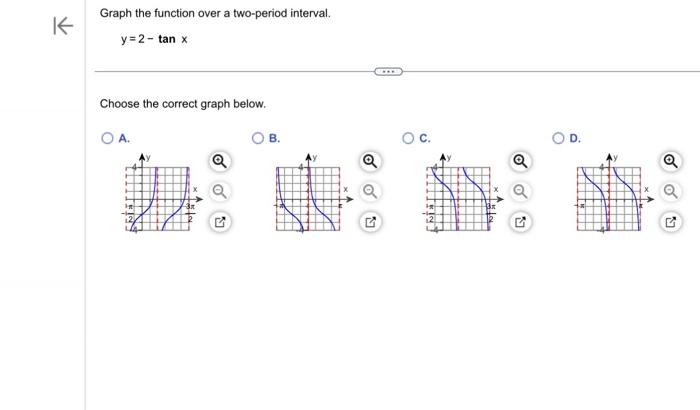
Have you ever gazed at a function’s graph and marveled at the mesmerizing patterns it reveals? The beauty of periodic functions lies in their cyclical nature, repeating every fixed interval. But here’s a playful question: which functions graph exhibits a period of precisely 2? This inquiry opens the door to an exploration of various mathematical forms that encapsulate this characteristic.
To embark on this journey, it is vital first to grasp the concept of periodicity in functions. A function is deemed periodic if it satisfies the condition ( f(x) = f(x + P) ) for all ( x ) in its domain and for some positive constant ( P ). This constant is known as the period of the function. Thus, our primary focus will be to discover functions whose period equals 2.
One of the quintessential examples of periodic functions is the trigonometric functions, particularly the sine and cosine functions. However, their standard periods are ( 2pi ). To derive a periodic function with a period of 2, we can manipulate these basic forms. The modified sine function can be illustrated as:
( f(x) = sin(pi x) )
The graph of ( sin(pi x) ) clearly delineates a periodicity of 2. This transformation from the standard sine function effectively compresses its graph horizontally. As a result, it achieves a rapid oscillation reaching a maximum and minimum within the interval of [0, 2].
Similarly, the cosine function can also be adjusted to possess a period of 2. The transformation can be represented as:
( g(x) = cos(pi x) )
Just like its sine counterpart, ( cos(pi x) ) also completes its oscillation within the span of 2 units. The resultant graph oscillates symmetrically around the x-axis, oscillating between -1 and 1.
Beyond trigonometric functions, polynomial functions can exhibit periodic behavior under certain transformations. One fascinating example emerges when considering the modulo operator, which can create repeating patterns. Consider the function:
( h(x) = text{mod}(x, 2) )
This function generates a sawtooth wave, which resets every 2 units. The behavior is particularly intriguing; as ( x ) increases, the function oscillates between 0 and 2, allowing us to visualize a simple, periodic function with a specified period.
Stepping outside the realm of polynomials and trigonometric representations, piecewise functions can also exhibit periodic intervals. For instance, we can define a piecewise function as follows:
( j(x) = begin{cases}
1 & text{if } 0 leq x < 1 \
0 & text{if } 1 leq x < 2
end{cases} )
This construction will yield a step function that alternates between the values of 1 and 0, hence asserting periodicity with a complete cycle every 2 units.
A noteworthy characteristic of periodic functions is their harmonic nature. These functions can be expressed as infinite sums of sine and cosine terms, often revealed through Fourier series. The fundamental frequency ingrained in such series can manifest in a period of 2 when appropriately configured. For instance, the series:
( f(x) = a_0 + sum_{n=1}^{infty} (a_n cos(n pi x) + b_n sin(n pi x))
end{cases}
)
This expression underscores the crucial role of harmonics in determining periodicity. If set correctly, even complex functions can exhibit a harmonious repetition reminiscent of their fundamental forms.
In addition, let us not overlook the periodicity that emerges through transformations of known functions. For example, introducing a linear transformation can alter the period of a function. The function:
( k(x) = tanleft( frac{pi x}{2} right) )
will also demonstrate a period of 2. The tangent function inherently carries a period of ( pi ), yet through this linear transformation, we observe a compression that reduces the period to 2.
In scrutinizing this intriguing landscape, one realizes that functions with a period of 2 can be more diverse than initially perceived. Transformations and combinations, patterns formed from harmonics or explicit constructs like piecewise, polynomial, or trigonometric functions, reveal a vibrant array of periodicities.
As one navigates through the world of functions, it becomes evident that these mathematical entities offer both complexity and beauty. Finding functions that exhibit a period of 2 is not merely an academic endeavor; it beckons an appreciation for the intricate dance of numbers and the elegance found in their recurring patterns. This exploration not only deepens understanding but also engages the curiosity inherent in mathematical study, merging intellect with art as we decipher the rhythm of the graphing realm.

Leave a comment