

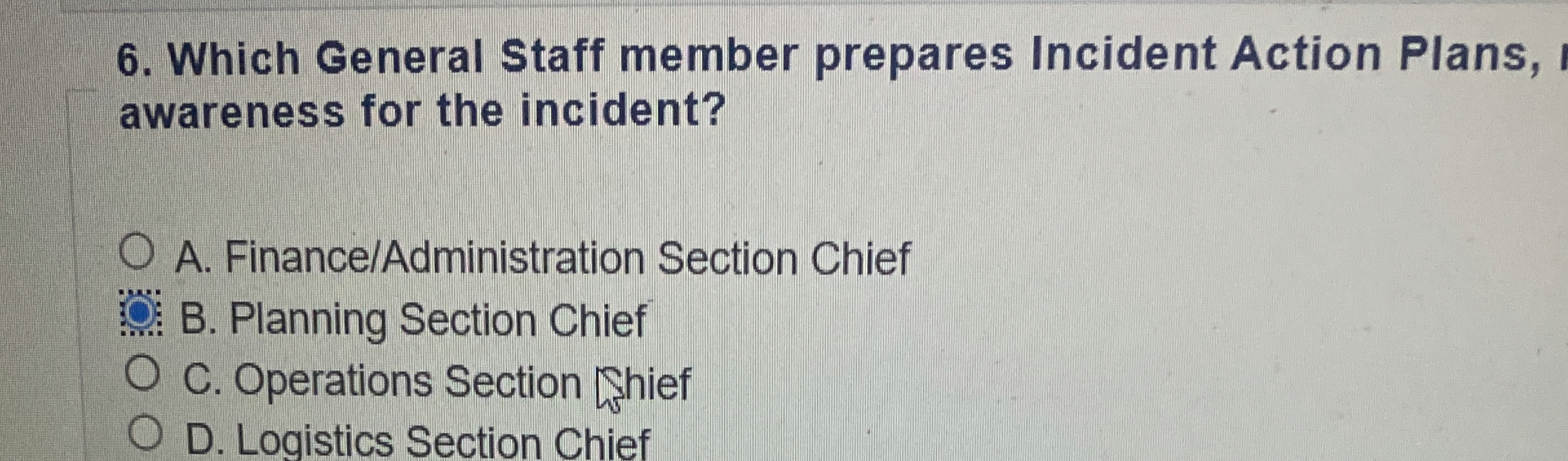
The Incident Action Plan (IAP) constitutes a pivotal component of operational effectiveness during emergencies and disasters. Within the hierarchical structure of incident management, determining which General Staff member is responsible for the preparation of these plans is essential for understanding the intricate dynamics of emergency response. This discourse elucidates the roles and responsibilities of various General Staff members in relation to the IAP, ultimately converging on the individual uniquely qualified for its elaboration—typically, the Planning Section Chief.
To commence, it is imperative to comprehend the overarching framework of the Incident Command System (ICS). This systematic approach is designed to enable efficient management of incidents involving multiple agencies and jurisdictions. Within this structure, the General Staff consists of four fundamental positions: the Operations Section Chief, the Planning Section Chief, the Logistics Section Chief, and the Finance/Administration Section Chief. Each of these roles contributes arrayingly to the collective objective of managing disasters and emergencies; however, it is the Planning Section Chief who assumes the crucial mantle of formulizing the IAP.
The Planning Section Chief orchestrates a multifaceted process that encompasses the gathering, analysis, dissemination, and application of information relevant to the incident. This role necessitates a keen aptitude for strategic foresight and analytical prowess. By synthesizing data from various sources—such as field reports, weather forecasts, and resource availability—the Planning Section Chief constructs a coherent narrative that informs operational decisions. Herein lies the foundation of the Incident Action Plan.
Within the preparatory stages of the IAP, the Planning Section Chief convenes with subordinate personnel and other General Staff members through collaborative discussions. Such gatherings are instrumental in fostering an expansive dialogue that captures diverse perspectives and insights. Through this collaborative engagement, pertinent objectives and strategies are codified into a coherent plan that delineates tactics for the ensuing operational period.
Moreover, the Planning Section Chief is tasked with visualizing the operational landscape. This individual frequently relies upon the use of Geographic Information Systems (GIS) and other advanced technological tools to map the incident terrain, evaluate hazards, and identify critical resource allocation points. The IAP not only embodies the tactical maneuvers necessary for addressing immediate concerns but also integrates long-term strategies that may impact recovery efforts in the aftermath of the incident. Thus, the role of the Planning Section Chief transcends mere response—it encapsulates a vision for resilience.
An important aspect of the Planning Section Chief’s responsibilities involves the ongoing assessment of the tactical implementation of the IAP. By maintaining situational awareness, this individual can adapt the plan in real time, ensuring its ongoing relevance as conditions evolve. Should new challenges arise, or if initial strategies fail to yield the desired effects, the Planning Section Chief must exhibit agility and decisiveness in reformulating the IAP to address emerging exigencies.
Transitioning from the intricacies of plan preparation, it warrants mention that the development of an effective IAP is inextricably linked to established protocols and procedures. The National Incident Management Assistance Teams (IMATs) and various emergency management frameworks delineate guidelines for the formation of IAPs, reinforcing the necessity for a standardized approach amid the chaos of a crisis. However, despite these established parameters, the Planning Section Chief retains the discretion to adapt methodologies suitable for the specific incident at hand, enhancing both ingenuity and operational fluidity.
In addition to tactical preparation, the Planning Section Chief’s role encompasses a profound commitment to stakeholder engagement. The IAP is not merely an internal document but serves as a communication tool to inform all relevant stakeholders—ranging from first responders to community leaders and citizens. By ensuring that the IAP is inclusive of diverse stakeholder inputs and addresses their respective needs, the Planning Section Chief fosters transparency and promotes collaborative resilience within the community.
Furthermore, as the incident transitions to recovery, the role of the Planning Section Chief morphs to encapsulate broader implications of recovery planning. This phase requires foresight and adept management in anticipating future challenges, underpinning the continuity of governance and community stability. The IAP, therefore, must not only encompass immediate response strategies but also align with long-term recovery objectives, forging pathways for rehabilitation and sustainable growth.
In summation, the intricacies surrounding the preparation of Incident Action Plans fundamentally converge upon the authority designated to the Planning Section Chief. This individual not only crafts the plan with meticulous attention to detail and strategic insight but also embodies the principles of flexibility, foresight, and stakeholder collaboration. As we navigate the complexities inherent in emergency management, recognizing the critical role of the Planning Section Chief invites a profound shift in understanding the collaborative nature of incident management and the vital importance of comprehensive, well-structured planning in mitigating the effects of crises. The locus of responsibility for developing IAPs highlights how, within the sphere of emergency response, effective leadership is pivotal in fostering both immediate survival and long-term recovery.

Leave a comment