

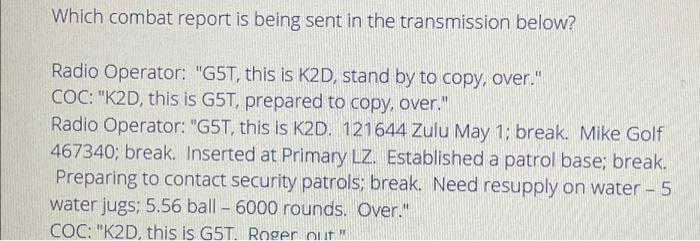
Decoding tactical messages, particularly combat reports, has captivated military strategists and enthusiasts alike. The elusiveness and specificity of these transmissions yield insights into broader operational and strategic frameworks. As complex as they are, combat reports embody the essence of military communication—accurate, concise, and laden with implications. This article endeavors to demystify the intricacies of a combat report, exploring the frameworks and methodologies that underpin their creation and transmission.
Understanding the Essentials of Combat Reports
At the core of military operations lies the combat report—a document or message designed to convey critical information amidst the chaos of warfare. Usually produced during or immediately after an engagement, these reports serve multiple purposes, including situational awareness, intelligence gathering, and post-operation evaluation. Combat reports are characterized by their brevity, clarity, and structured format, which often includes operational details, location, enemy disposition, and recommendations for subsequent actions.
The format of these reports typically adheres to established military protocols, ensuring that the information is rapidly disseminated and easily understood by various units. Among the common elements are headings that highlight the type of report, time of incidence, and personnel involved. The format provides not just information but a narrative that interconnects actions taken and future projections.
The Linguistic Nuances of Tactical Communication
The language employed in combat reports is notably distinct and is designed to eliminate ambiguity. Operators often utilize jargon, acronyms, and codified terms that may be inscrutable to the uninitiated. For instance, terms like “engaged” and “interdicted” have specific meanings in the military lexicon, denoting particular actions that have strategic implications. This specialized language allows for efficient communication; soldiers can relay complex operational details in a succinct manner.
Moreover, indigenous colloquialisms may emerge in these reports, adding a unique layer that reflects the cultural backdrop of the personnel involved. Such linguistic elements enhance the richness of the narrative while simultaneously reinforcing camaraderie among units—what might come across as mere jargon to outsiders can often evoke a sense of shared identity within military circles.
Contextualizing the Report: Tactical and Strategic Implications
A crucial aspect of interpreting a combat report lies in the context surrounding it. Combat engagements do not occur in a vacuum. Understanding the strategic landscape, including the geopolitical ramifications and operational objectives, is paramount. For instance, a report detailing a skirmish with insurgent forces in a key territory may indicate a broader strategy of counterinsurgency or territorial reclamation. Analysts must scrutinize the nuances within the report to grasp what the documented actions signify in the larger campaign.
Inferences drawn from these reports can pivot on temporal elements. For example, the timing of the report in relation to other military actions, weather conditions, troop morale, and even international diplomatic nuances can vastly influence interpretations. Analysts are engrossed in correlating these factors to deduce not just the events of a skirmish but the intentions and capabilities of command-level strategists.
The Role of Technology in Transmission and Decoding
Modern warfare has revolutionized the transmission of combat reports, amplifying the speed and efficiency with which information can be conveyed. The advent of digital communication tools and secure networks allows for immediate reporting on the battlefield, enabling commanders to make informed decisions in real time. However, this technological advancement does not come without its challenges; cybersecurity threats and information warfare complicate what was once a straightforward process.
Decoding these messages requires not just linguistic skill but also technical aptitude. Cyber operators and intelligence analysts can employ sophisticated decryption tools to analyze encrypted communications, extracting essential insights that can function as precursors to tactical movements or strategic assessments. The intersection of technology and tactics signifies an evolving battlefield where traditional notions of report transmission are continuously challenged.
The Psychological Dimensions of Combat Reporting
Beyond mere data conveyance, combat reports embody psychological dimensions that warrant exploration. The act of documenting an encounter not only serves operational needs but also functions as a method of psychological processing for combatants. Writing, in this context, acts as a cathartic exercise, allowing individuals to articulate the chaos and emotion experienced in combat. The report can contribute to morale, affirming the integrity of mission objectives while fostering a sense of accomplishment despite the perils of battle.
Furthermore, the potential impact of these reports on public perception and domestic morale cannot be understated. The dissemination of information, particularly in democratic societies, can influence political discourse surrounding military operations. A combat report that portrays a decisive victory can bolster public support for military engagements, while one that highlights failures or casualties may trigger widespread dissent.
Conclusion
Decoding tactical messages encapsulated in combat reports requires a multifaceted approach, considering linguistic subtleties, contextual variables, technological advancements, and psychological implications. Each report serves as a critical element in the greater tapestry of military operations, informing strategies and shaping narratives both on and off the battlefield. This complexity is what renders combat reports endlessly fascinating, revealing layers of meaning that extend far beyond the field of combat, into the realms of strategy, communication, and human experience.

Leave a comment